


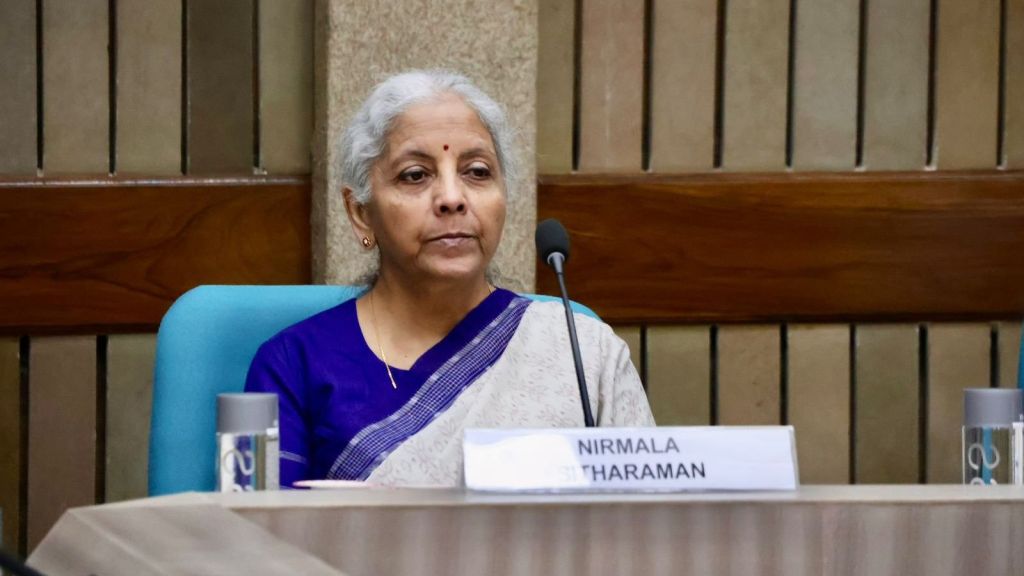
 Finance Ministry warned on Thursday that India “cannot afford to rest on its post-Covid growth laurels” due to the geopolitical and geoeconomic uncertainty that plagues the world. (Express photo by Renuka Puri)
The Ministry of Finance is projecting a GDP growth rate of 7.3% in the July-September quarter, far higher than the 6.4% forecast by the Reserve Bank of India (RBI).
“Growth momentum has extended into Q2 FY27, though at a more measured pace,” the finance ministry said in its Monthly Economic Review report for September, released on Thursday. “Our nowcasting measure, unveiled in the Economic Survey earlier this year, anticipates a real GDP growth rate of 7.3% in the fiscal second quarter,” it added.
GDP data for July-September will be released by the statistics ministry on November 30.
Nowcasting is a type of forecasting method that uses very recent data to constantly update predictions for the immediate future. In this regard, the RBI’s forecast of 6.4% was made on August 5, well before statistics ministry data showed on August 31 that GDP growth in the April-June quarter came in at an unexpectedly high 7.8%. This was well above the central bank’s forecast of 7%.
The RBI’s Monetary Policy Committee is set to meet next week and announce its interest rate decision on October 7 – it is increasingly seen raising interest rates by 25 basis points to 5.5% – when the central bank will also update its economic projections, including those for growth and inflation. Currently, it expects GDP growth to average 6.7% in 2026-27.
With India’s growth exceeding expectations for some time now, numerous economists and organisations have raised their forecasts in light of the rapid April-June figure of 7.8%. On September 23, four international agencies – S&P Global Ratings, Fitch Ratings, the Organisation for Economic Co-operation and Development (OECD), and the Asian Development Bank (ADB) – hiked their growth forecast for the current fiscal by 40–80 bps to 6.9–7.1%.
However, the finance ministry warned on Thursday that India “cannot afford to rest on its post-Covid growth laurels” due to the geopolitical and geoeconomic uncertainty that plagues the world.
“It has to be earned every quarter. That is the challenge for policymakers,” the report said.
Noting that global conditions have “turned unfavourable again”, the finance ministry report said that surging oil prices, rising global bond yields, “unsettled” trade relations with the US, and the AI bubble having “not begun its inevitable meaningful deflation” mean that India, and other developing nations, “faces a stiff challenge to attract capital flows”.
“Indications are, however, that foreign direct investment inflows, on a net basis, should do better this financial year than last. Thus, short-term pressure on Indian assets, including the currency, remains,” it further said.
“Over time, as some of these clouds inevitably dissipate, India’s intrinsic growth potential will earn the attention it deserves from investors,” it said, adding that the country must keep working to become more competition-friendly, rather than business-friendly, as only a competitive economy will become a successful, innovative, and manufacturing economy. “Improved governance and enhanced state capacity at all levels of the government hold the key to a competitive Indian economy.”
Despite its rapid growth, the Indian economy has been facing pressures on the external front, with the exit of foreign capital from domestic financial markets and subdued Foreign Direct Investment (FDI) inflows over the last couple of years exerting tremendous pressure on the rupee. Having almost breached the 97-per-dollar mark in May, the rupee is current trading at 95.98, lifted slightly by the RBI’s concessional swap windows drawing $133 billion as Foreign Currency Non-Resident (Bank) deposits in just three months.
So far in 2026–27, foreign investors have sold Indian stocks and bonds to the tune of $9.36 billion on top of the $16.59 billion of sales in 2025–26. Meanwhile, the situation has improved slightly on the direct investment front, with net FDI in July rising to an over five-year high of $7.35 billion, leading to net inflows in the first four months of 2026-27 being $13.43 billion. This is a vast improvement from 2024–25 and 2025–26 together seeing net inflows of just $7.7 billion.