


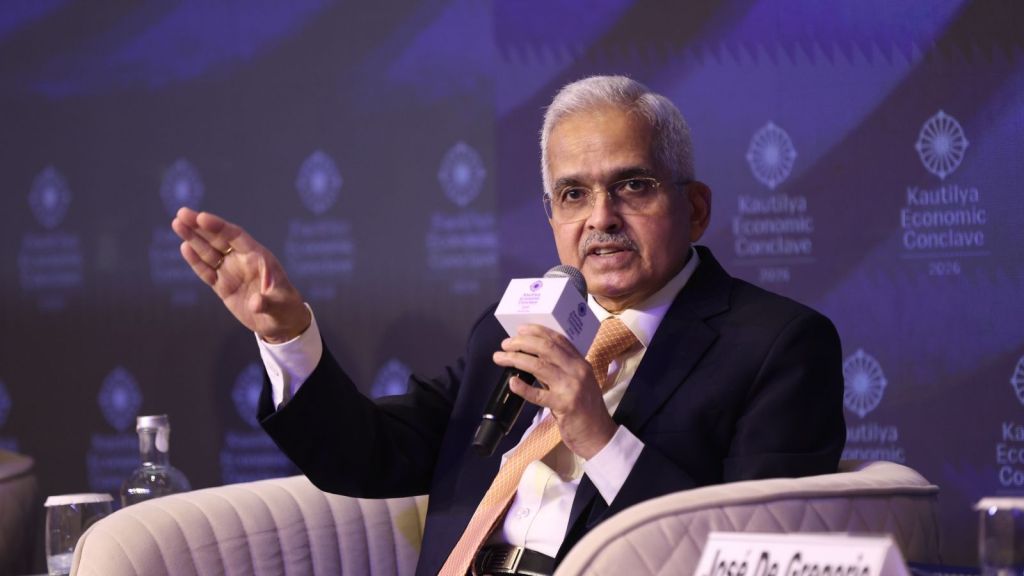
 On the external front, Das said India's financial sector and prudent management had also emerged as strong pillars of economic growth. (Image: Ministry of Finance)
Amid sustained shocks and global uncertainties, India seeks to emphasise on sustained structural reforms, building domestic capacity and competence in areas where there is large import dependence, and continuously focusing on fiscal, monetary, macroeconomic and macrofinancial stability, Shaktikanta Das, Principal Secretary-2 to the Prime Minister, said on Sunday. Das further said that the country stands at a pivotal moment in its development journey and “a leap to Viksit Bharat 2047 is in the realm of realisation”, adding that India is within a striking distance of 8% growth.
“There can never be a moment where you can say that, whatever I have done is sufficient. There is always something more to do but in the current context… The emphasis has been to build our domestic capacity, competence in areas where we are largely import dependent. So, whether it is energy or fertiliser and so many other areas, the government is now focusing on such areas… the focus of the government is also to take measures and to develop long-term capacity in areas where again we are dependent on imports,” Das said while answering a question on day two of the three-day Kautilya Economic Conclave organised by the Ministry of Finance and the Institute of Economic Growth.
Calling for strategic self-reliance, Das said self-reliance or Atmanirbharta should not mean isolation. “Rather, it stands for building stronger domestic capabilities while remaining integrated with global markets and concluding more free trade agreements,” he said.
Das underlined that India’s real GDP grew by an “impressive 7.8%” in Q1 of 2026-27, adding that if the period from July-September 2025-26 to April-June 2026-27 is taken into account, “real GDP growth in India just exceeds 8%”. “This resonates with my statement to Financial Times London a few months ago that India is within a striking distance of 8% growth,” he said.
Reforms undertaken over the past decade were not one-off measures but were designed to build buffers that would help the economy absorb disruptions and recover rapidly, he said. “India’s resilience is not accidental. It is the outcome of broad and mutually reinforcing reforms,” he said.
The former Reserve Bank of India governor cited flexible inflation targeting, the introduction of the goods and services tax, fiscal prudence, the push for digital payments and banking sector reforms among such measures.
On the external front, Das said India’s financial sector and prudent management had also emerged as strong pillars of economic growth. External sector indicators have remained broadly resilient, supported by export diversification, free trade agreements, a sustained surplus in services trade and steady inward remittances, he said.
Going ahead, Das said India must harness the artificial intelligence (AI) revolution to sustain high growth. “India’s AI strategy rests on two complementary pillars. First, sovereign AI capability through investments in indigenous foundation models, high-performance computing infrastructure, semiconductor developments and robust innovation ecosystem,” he said.
He also called for deepening the financial sector to support India’s expanding economic weight. “While India’s financial sector has evolved significantly, the next phase of growth will require strengthening of long-term finance and patient capital,” Das said. This would require further deepening of the corporate bond market, pension and insurance funds, municipal finance and innovative infrastructure financing, he added.