3 min read

Journalism of Courage



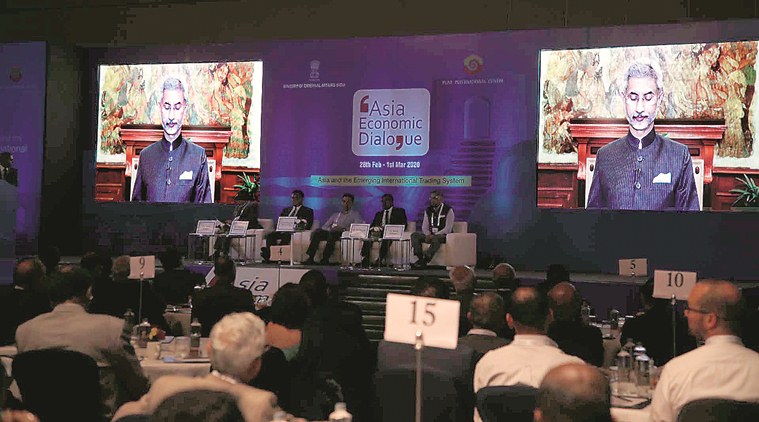 Foreign Minister S Jaishankar at Asia Economic Dialogue, via video link. (Express photo: Ashish Kale)
External Affairs Minister S Jaishankar said on Friday that trade-related decisions could not be taken without accounting for their impact on livelihood and social stability. He was speaking via a video link at the inaugural Asia Economic Dialogue at the Pune International Centre here.
The minister, without naming any country, said those who were urging India to open up its market were themselves taking protectionist measures.
“Competing against those with structural advantages cannot be a casual decision justified by political correctness … The past record shows lack of adequate homework and absence of effective standards end up hollowing out many sectors … Many trade-related decisions have direct livelihood and social stability consequences. This is obviously not unique to India, but it is paradoxical that those who urge us to be more open are even more sensitive themselves on this score,” he said. India and the United States have been trying to finalise a trade deal for the last few years now.
“Today as conversations about trade between nations get more animated, there is less pretense that we are also talking about the parallel exercise of political influence … Trade has never been politically neutral. It is even less so now,” he said. He hinted that linkages to non-trade issues could be one of the stumbling blocks in finalising the deal.
“Reaching an international understanding on issues of trade … is naturally more challenging than in the past. As economic thinking has narrowed in many societies, and trade interests more sharply defined, there is a greater element of a zero-sum game. Linkages to non-trade issues, whether of a social nature or a security concern, have added further to the challenge,” he said.
Emphasising that trade was key to ensuring a multipolar world, Jaishankar said it was in the interest of the world to have more countries powering the global economic growth. The minister said building up infrastructure might be the most crucial comparative advantage for India in the long run.
“Making it easier to do business or to ensure easier living can make some difference. But evolutionary change may not be enough in transformational terms. Each of us has to devise their course and India’s prospects are heavily focused on improvement in infrastructure. At the end of the day, this may be one of the defining elements of its comparative advantage. Getting politics, economics and governance all right at the same time is therefore critically important,” he said.