


© The Indian Express Pvt Ltd
Tags:


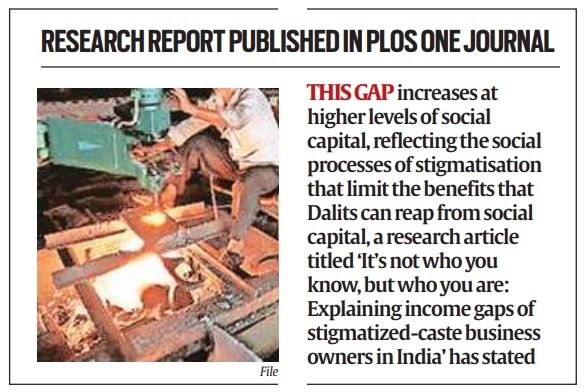
Business owners from stigmatised groups such as Dalits experience a business income gap of around 16 per cent compared with others, including those business owners who are from communities that are disadvantaged but are not similarly stigmatised, a new study has revealed. This gap increases at higher levels of social capital, reflecting the social processes of stigmatisation that limit the benefits that Dalits can reap from social capital, a research article titled “It’s not who you know, but who you are: Explaining income gaps of stigmatized-caste business owners in India” has stated.
The research report published in PLOS ONE journal on August 7 this year is authored by Prateek Raj, Assistant Professor in Strategy at Indian Institute of Management Bangalore (IIMB) along with Thomas J Roulet, Professor of Organisational Sociology and Leadership at Cambridge Judge Business School and Co-Director of the King’s Entrepreneurship Lab at King’s College; and Hari Bapuji, Professor in the Department of Management and Marketing, Faculty of Business and Economics, The University of Melbourne, Australia.

The report, which states human capital and social capital as two potential tools to facilitate economic mobility and to reduce inequalities, has attempted to find out whether these tools work equally well for stigmatised groups, particularly in societies with systemic inequalities.
There is a high income gap for stigmitased groups and instead of getting reduced, this gap increases at higher levels of social capital. However, Dalits can reap similar income benefits as others from human capital, the report said, adding that human capital helps stigmatised groups mitigate the implications of stigma, but social capital does not.
“That social capital fails to improve the incomes of Dalits as much as they do for others. We know from past research that social capital benefits people in business. So, it is commonly assumed that they will benefit everyone equally. Our study shows that that is not the case. We were surprised to find that other groups, including groups that are disadvantaged due to caste (e.g., OBCs, STs) and religion (e.g., muslims) benefit from having social capital and improve their incomes. But, for Dalits (SCs), the social capital does not help as much. We argue that this is because Dalits face a stigma that is attached to them as persons and is perpetuated in social interactions,” the research paper’s author Prateek Raj told The Indian Express.
To address income disadvantages faced by the marginalised groups, that is, OBCs, adivasis/STs and muslims, it is adequate to provide them opportunities, for example, in the form of business leads, credit facilities, collaterals for large orders, Hari Bapuji, the co-author of the study, said. While noting that the government has developed several initiatives for the mobility of Dalits and other disadvantaged communities, the study states that the stigmatised groups (Dalits) and other historically disadvantaged–but not similarly stigmatised groups) face different social processes, which need to be considered in designing initiatives to reduce inequalities. There is a need to rethink development strategies involving human capital and social capital, the study said.
“Since Dalits/SCs not only face marginalisation but also experience institutional stigma, it is necessary to counter the social processes that stigmatise them. For example, the destigmatisation strategies can include education (e.g., curriculum that discusses the historical injustices and educates on the ways inclusion is achieved globally), employee training (e.g., inclusion of caste as an axis for diversity efforts in Indian corporates), preferential procurement (e.g., similar to what MNCs in the West do for businesses owned by women and racial minorities), eliminate barriers that prevent Dalits from reaching elite spaces (e.g., corporate top management, university faculty, judges, bureaucrats). In other words, these efforts need to be multifaceted, and all stakeholders should join; they should not be limited to the government, courts, or NGOs,” Bapuji said.
Earlier in March this year, the high economic and income inequality prevalent in India was flagged by a paper released by the World Inequality Lab. As per that report, top 1 per cent income and wealth shares have reached historical highs in India and are among the very highest in the world. By 2022-23, the top 1 per cent income share in India was 22.6 per cent and the top 1 per cent wealth share rose to 40.1 per cent, with India’s top 1 per cent income share among the very highest in the world, higher than even South Africa, Brazil and the US, the report had said.
Business owners who face institutional stigma, that is, Dalits, have a lower income compared to those who do not face such stigma, that is, non-Dalits including those who face socioeconomic disadvantage such as OBCs, adivasis, and muslims, the study released this month said. “This income gap is higher at higher levels of social capital, especially bridging social capital, suggesting that institutional stigma inhibits the degree to which stigmatised individuals are able to leverage their social capital, as compared to non-stigmatised individuals. In contrast, human capital, in the form of education, improves the incomes of Dalits to a similar degree as it improves the incomes of non-Dalits,” it said.


