4 min readNew DelhiJun 21, 2024 07:26 AM IST
First published on: Jun 21, 2024 at 04:02 AM IST
As private investment continues to be a concern, the Indian industry has sought a status quo on corporate tax rates and expansion of the government’s flagship Production Linked Incentive (PLI) scheme to labour-intensive sectors that bore the brunt of demand slowdown in the West following Covid-19 lockdowns.
Finance Minister Nirmala Sitharaman on Thursday chaired a pre-Budget consultation meeting with prominent players in the capital market and heads of industry lobby groups in the presence of senior officials of the Finance Ministry. They discussed a range of issues from challenges in green transition to addressing the sticky food inflation.

Industry representatives from the Federation of Indian Chambers of Commerce & Industry (FICCI) and the Confederation of Indian Industry (CII) sought an increase in the capital expenditure outlay for FY25 by 25 per cent to Rs 11.8 lakh crore and a status quo of corporate tax to improve investment climate in the country.
The pre-Budget meeting that comes ahead of the Goods and Services Tax (GST) Council meet on June 22 saw discussions on a fresh set of reforms in the tax structure. FICCI sought to reduce the GST to a maximum of three slabs and inclusion of excluded sectors. The industry lobby group in a statement stated there should be a revamp of GST law to have minimal friction in achieving pass through of all input tax credits in the entire value chain.
Amid concerns over imports of laptops, Vivek Jalan, chairman of National Fiscal Affairs and Taxation Committee, Bengal Chamber of Commerce, said that the government should not restrict import of electronics items like laptops until Indian production meets the demand.
“Till India becomes atmanirbhar in electronics trade, import will be the mid-term sourcing model. With advancement of technology products are coming with additional features and there is great hardship. For import of laptops, for example, one has to take the following approvals: DGFT import licence, E-waste EPR, Plastic waste EPR, Battery waste EPR, BIS certifications and WPC licence if it has wireless connectivity. Till India becomes self-sufficient, the non-tariff barriers may create scarcity and consequential inflation. Hence, we request to re-consider the non-tariff barriers,” Jalan said in a statement.
Rakesh Nangia , founder and managing partner , Nangia & Co LLP said that the Assocham’s Tax Council suggested making the default new tax regime for individuals more attractive for the salaried and middle-income groups by increasing the basic exemption limit, standard deduction, and rationalising the slab rates’ income categories.
“The council also proposed extending the beneficial 15 per cent tax rate made available to new manufacturing units. This extension would enhance India’s appeal for capital investments, push the “Make in India” agenda, and stimulate the domestic economy,” Nangia said.
The PHD Chamber of Commerce and Industry (PHDCCI) suggested that more focus should be given on tier 2 and 3 cities to build state of the art infrastructure and smart villages with adequate facilitation of public utilities.
“Reduce costs of doing business including costs of capital, costs of power, costs of logistics, costs of land and costs of compliances and implement the four labour codes across the states to enhance the competitiveness of the industry,” PHDCCI said.
PHDCCI also recommended status quo on the corporate tax rate at 22 per cent for existing companies and 15 per cent for new manufacturing companies incorporated after October 1, 2019 to enhance the manufacturing share in GDP.

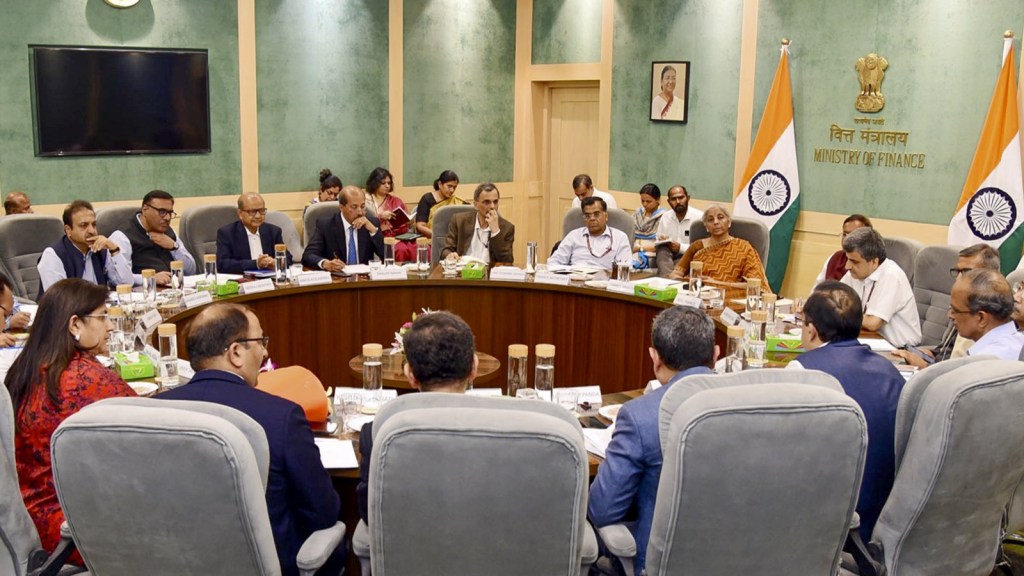 FM Nirmala Sitharaman at a pre-Budget meeting with industry leaders and associations. (PTI)


 Share


