


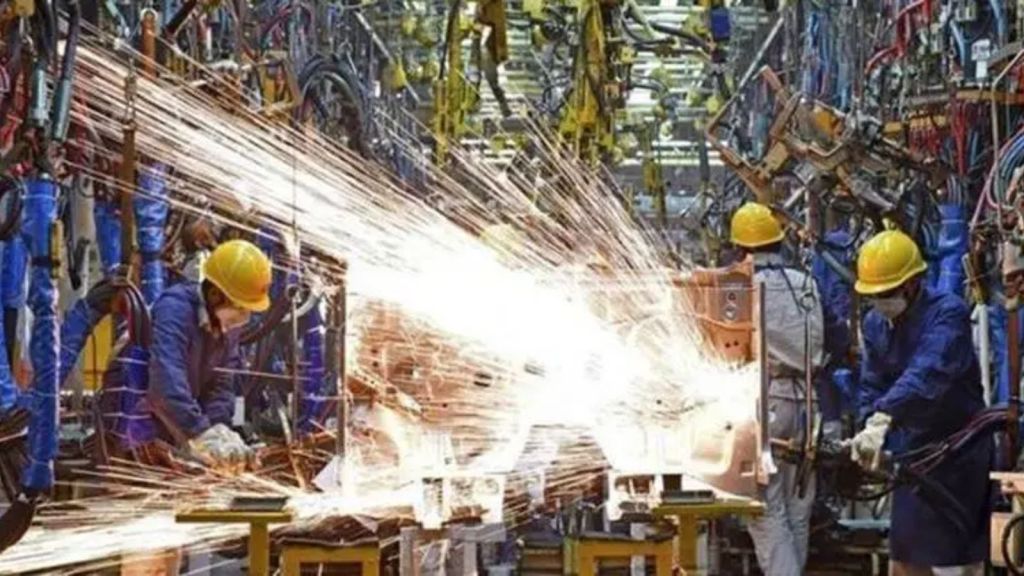
 The IIP comprises four key sectors, with manufacturing accounting for three-fourth of the entire index. (Representative Image)
The Indian economy continued its impressive run, with data released Monday showing industrial production in August was 8% higher compared to the same month last year, although a favourable base effect helped drive overall growth as well as that of the manufacturing sector, whose output rose 9%.
Policymakers, however, will keep an eye on the consumer goods segment.
While production of durable goods rose 11.1% in August, following up a 12% increase in July, non-durable goods – which are primarily fast-moving consumer, or FMCG, products – saw a growth of only 2.1%.
According to Rajani Sinha, Chief Economist at CareEdge Ratings, the overall strong industrial performance is in line with other data such as GDP growth, lending, and exports, indicating that the economy has “held up well” despite persistent global uncertainties and elevated energy prices. And while the performance of consumer durables continues is a positive for consumption, “the feeble performance of consumer non-durables remains concerning.”
Consumer durables and non-durables are key indicators of household demand. And while production of durables is strong, analysts have been sounding caution ahead of the festival season, which sees Indians splurging on new purchases. But with prices of consumer electronics rising for a variety of reasons – significantly more expensive memory chips and other key inputs such as copper and aluminium as well as increasing freight costs – demand may face headwinds.
However, Indians are seen relying on loans to make purchases, with UBS analysts predicting last week that India is entering a “strong unsecured credit growth cycle, led by personal loans”.
Latest data from the Reserve Bank of India shows that while personal loans given by banks were up 16.2% as at the end of July, those given by non-banks were up 21.4%.
Favourable base and GST rate cuts
Industrial growth as per the Index of Industrial Production (IIP) was 7.4% in July and 4.7% in August 2026. The IIP comprises four key sectors, with manufacturing accounting for three-fourths of the entire index.
The August industrial growth print of 8% is the latest in a series of robust economic numbers, with June having posted an expansion of 8.8% – the highest since 19% in March 2024. So far in the first five months of 2026-27, or April-August 2026, industrial growth has averaged 6.7%, well above 4.2% in the same period of 2025-26.
“If this is maintained, India can register growth of 7-8% for the year on the back of higher growth during the festival season with demand building up. This makes the third quarter very critical for industry,” said Madan Sabnavis, Chief Economist at Bank of Baroda.
A favourable base effect usually occurs when output either stagnated or fell in the year-ago month – which is used to calculate the growth rate for the latest month. As such, this favourable base meant the year-on-year growth rates in August 2026 for industrial output as a whole and the manufacturing sector were impressive even though production was down compared to July 2026: manufacturing output was down 1.4%, while overall industrial production was 1.8% lower.
According to Rahul Agrawal, Principal Economist at ratings agency ICRA, the favourable base effect in August 2026 was because of ‘inventory recalibration’ in August 2025 ahead of the widely-expected cuts in the Goods and Services Tax (GST) rates, that were announced by the GST Council in early September 2025 and came into effect later that month on the 22nd.
Prime Minister Narendra Modi, in his Independence Day speech last year, had spoken of GST reforms. As a result, sellers looked to reduce their stocks of goods as they waited for the new GST rates to kick in. The reforms reduced the indirect tax rates on hundreds of goods and services, which were passed on to consumers in the form of lower prices.
Industry performance
Within the manufacturing sector, 18 of the 23 categories posted higher year-on-year growth in their output in August. According to Devendra Pant, Chief Economist at India Ratings & Research, underlines “generalised improvement”.
“Like previous months, electrical equipment and motor vehicles continued to record strong growth of 30.9% and 25.2%, respectively,” Pant noted, adding that the former’s performance is indicative of “growing domestic and external demand for Indian manufactured electrical goods”.
The sharpest sectoral month-on-month fall in August was for mining and quarrying, whose output slumped 9.2% from July. Mining and quarrying, which accounts for over a tenth of the IIP, usually suffers during the monsoons as rains hinder mining activity. On a year-on-year basis, mining and quarrying output was down 5.6% in August.
A favourable base also helped push up the output of the ‘electricity & gas supply’ sector to 12.3% in August, although it was the only sector to post a sequential improvement in production. However, this month-on-month output increase was a mere 0.3%.
The impressive year-on-year growth in ‘electricity and gas supply’ was despite a 2.4% contraction in gas supply, with the electricity component doing all the heavy lifting. Electricity generated from renewable sources rose 15.4% year-on-year in August, while non-renewable sources posted an increase of 12.3%.
In terms of goods, three of the six categories posted double-digit growth rates in August: capital goods (16.9%), intermediate goods (13.7%), and consumer durables (11.1%).
Production of primary goods was up 3.5%, while that of consumer non-durables was 2.1% higher.
Even during April-August 2026, output of consumer non-durables is up only 1.2% year-on-year. This was on top of a muted 2.1% growth in the same five months of 2025.