


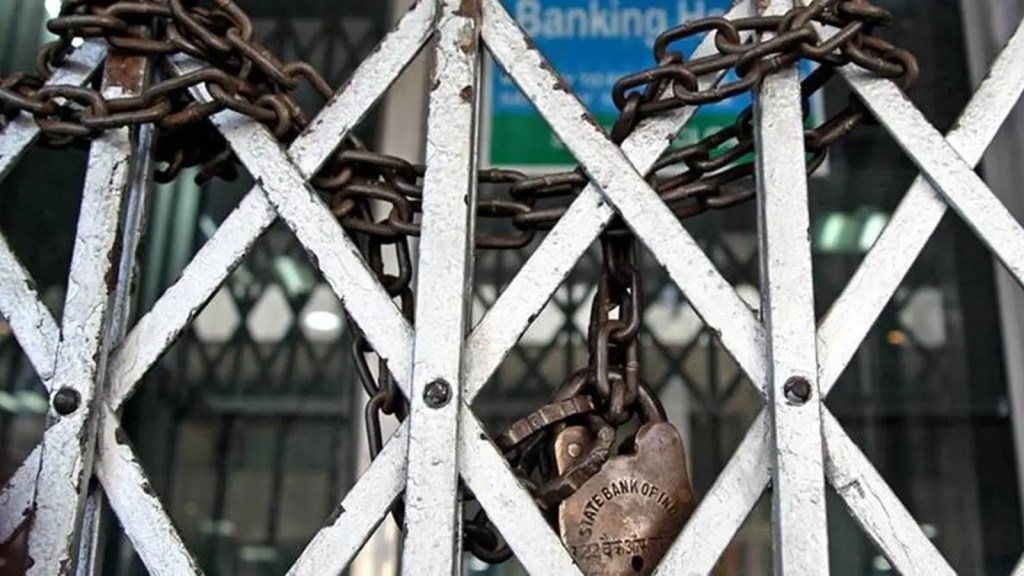
 The strike has been deferred by the bank unions after reaching an understanding with the IBA over the contentious issue of declaring a five-day working week for banks. (File Photo)
In a late-night development on Sunday, following discussions between the Indian Banks’ Association (IBA) and United Forum of Bank Unions (UFBU), the bank unions deferred their planned three-day strike beginning Monday. The bank unions agreed to defer the strike after reaching an understanding with the IBA over the contentious issue of declaring a five-day working week for banks.
“After due deliberations, it was decided that a high-level committee of IBA and UFBU will be formed immediately to deliberate on the issue of declaring the remaining Saturdays as holidays. This committee will explore all possible alternatives, discuss with all stakeholders, and work out a solution acceptable to all stakeholders and, more importantly, the customers,” the UFBU said in a joint statement representing seven bank unions.
The meeting between the IBA and the UFBU was held at 2130 IST, following which the UFBU issued a statement announcing the deferment of the three-day strike.
On the issue of the withdrawal of the performance-linked incentive scheme for Scale IV and above bank officers, the unions said discussions could start with the IBA proposing modifications to the scheme to the government to address the unions’ demands. The residual issues will be discussed between the parties for expeditious resolution, the UFBU said.
The UFBU, an umbrella body of several banking unions representing workers and officers, had announced a strike from Monday (September 28) to Wednesday. Among their key demands was a call for a five-day working week to replace the six-day working week at present.
The UFBU had stated that Indian banks earlier worked from Monday to Friday, with a half-day on Saturday.
The proposed three-day strike period, from September 28-30, was to coincide with the half-yearly closing of banks on September 30, significant for reconciliation, provisioning, and treasury and market operations. In its appeal to bank employees on September 21, the Ministry of Finance had said that a disruption of this nature, combined with the preceding weekend, would result in an effective five-day closure of banking services at a particularly sensitive point in the financial calendar, causing considerable inconvenience to customers, businesses, government transactions, and international banking operations.
“Strikes cause disruption in banking services that inconvenience the public, impact the business of the bank, and ultimately harm the interests of bank employees,” the Ministry had stated.
On September 23, the Ministry had then directed public sector banks and regional rural banks to function as normal on September 27 (Sunday), ahead of the proposed three-day nationwide bank strike.
Bank unions had earlier stated that it was assured that, in due course, efforts would be taken to declare all Saturdays as holidays after an agreement in 2015 had led to the second and fourth Saturdays of every month being declared bank holidays, while the remaining Saturdays were declared full working days.
“Already, there is 5 days working per week in the Central Government, State Government, RBI, LIC… private companies, stock market, money market, foreign exchange market, etc.,” the UFBU had said earlier in a release.