


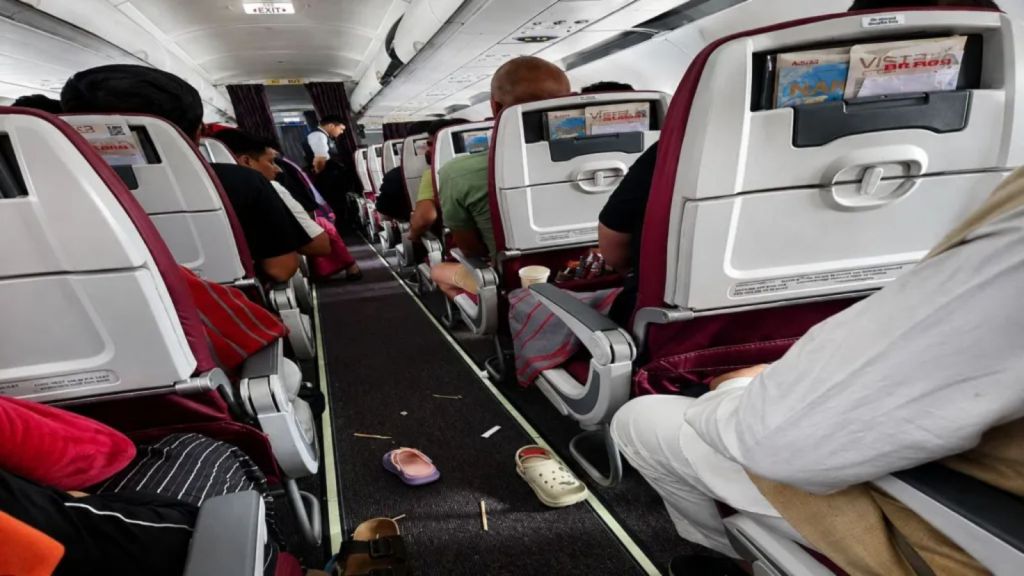
 The plane fell 300 feet mid-air and 24 people were injured. (ANI Photo/ Image enhanced using AI)
In the wake of an Air India pilot testing positive for drugs after the aircraft he was commanding lost altitude all of a sudden while flying from Phuket to Delhi, the Directorate General of Civil Aviation (DGCA) has ordered all Indian airlines to conduct a one-time test for psychoactive substances on all pilots by July next year, The Indian Express has learnt.
Sources said the direction to airlines was issued in August and testing has already begun. Indian airlines are estimated to have close to 14,000 pilots.
Following the August 4 incident involving the Phuket-Delhi flight, and before the DGCA direction, the Air India Group had voluntarily initiated one-time random drug tests on an estimated 5,000 pilots employed by Air India and Air India Express.
On September 4, hours after the Aircraft Accident Investigation Bureau flagged the positive drug test of the pilot-in-command of the Phuket-Delhi flight, Air India said it had terminated the pilot’s employment.
According to Civil Aviation Minister K Rammohan Naidu, the draft of the new, and likely more stringent, norms on testing aviation personnel for psychoactive substance use is likely to be released by the DGCA by the month-end.
In August, Naidu had said that the Ministry of Civil Aviation suggested to the DGCA that all pilots should undergo a dope test once a year, against the current regulation that requires 10 per cent of the pilots to undergo random testing annually.
Sources said while the DGCA was already in the process of revising the regulations pertaining to testing of aviation personnel for psychoactive substances, the Air India incident led to calls for a more stringent drug testing protocol and stricter disciplinary action in proven instances of drug abuse. While consultations for revising the rules were on, the regulator decided to put all airline pilots through a one-time drug test over the course of nearly 12 months.
In the current DGCA Civil Aviation Requirements (CAR) on testing for psychoactive substances, effected January 31, 2022, pilots and air traffic controllers are seen as the primary focus segments, with annual random testing of 10 per cent of these two employee segments being mandatory.
The rules also extend to the broader range of aviation personnel engaged in safety-sensitive functions, like aircraft maintenance engineers and certifying staff, trainee pilots, and instructors and examiners. They are required to be tested at the time of hiring or after specific incidents.
As per the DGCA CAR, the urine sample of the employee on whom the test is being conducted is to be split and stored in two separate containers. The testing process begins with a screening test on the sample in the first container, which is done immediately after the sample is collected. If this initial test is ‘non-negative’, which means it is indicative of the presence of psychoactive substances, the pilot is immediately taken off flying duty, pending the results of a confirmatory test.
The sample in the second container is then sent for the confirmatory test at a designated laboratory using high-complexity instrumentation. Confirmatory testing is required as preliminary screenings can return false positives due to consumption of certain medications and food items, as well as technical errors.
If the confirmatory test is positive, the medical in-charge of the concerned organisation is required to consult a medical review officer (MRO) to determine if the positive result was due to a legitimate therapeutic treatment or some other innocuous source, and not drug abuse. For instance, pain relief medication containing codeine may trigger a positive result for opiates. If the MRO confirms the result is a positive case of drug use, there is an escalation ladder of disciplinary actions that comes into the picture.
If it is the first occasion of a positive drug test, the employee is referred by his or her organisation to a specialist doctor, counsellor, or de-addiction centre for a rehabilitation programme. To return to active duty, the employee must undergo new testing, receive a negative report, and obtain a fitness certificate from the organisation’s medical in-charge.
If the employee who returned to duty after a first offence is found positive again, his or her licence is suspended for three years. A third positive test result leads to the cancellation of the person’s licence.