Akasa Air’s management has termed its decision to sue some pilots who quit the fledgling airline recently without serving the regulation notice period as “employee centric” with regard to the carrier’s current workforce. It has also assured employees that the airline will not shut down as it is armed with strong financials and long-term plans.
“Some people have questioned whether it is employee centric to seek legal remedy against former employees. Since these acts have caused disruption and disrespect to the great work done by our current employees, the most employee centric thing we can do is to remain fiercely protective of your future and the promise we have made to our customers,” Akasa Air’s Chief Executive Officer Vinay Dube told employees in an e-mail, a copy of which was seen by The Indian Express.

The airline, which began operations in August 2022, is in the news for moving court against over 40 pilots who resigned and quit without serving their notice periods of six months to a year, claiming that their abrupt exit had led to a number of flight cancellations leading to operational losses and damage to the carrier’s reputation. Most of these pilots are understood to have accepted offers from Air India Express, which, like Akasa Air, operates Boeing 737 family of aircraft.
Apart from seeking that these pilots be directed to serve the full notice period as mentioned in their contracts, the 13-month-old airline has also sought crores of rupees in compensation from each pilot for loss of operational profits and damage to its reputation due to their sudden exit, sources said. Akasa Air is also understood to have sought the intervention of sector regulator Directorate General of Civil Aviation (DGCA) and the Ministry of Civil Aviation in the matter.
Akasa Air is also understood to have sought the intervention of sector regulator Directorate General of Civil Aviation (DGCA) and the Ministry of Civil Aviation in the matter.
Dube told employees that Akasa Air has rationalised its network over the past month in the face of sudden resignations from some pilots, and attempted to allay any fear of an uncertain future for the airline. “Our commitment to be reliable remains sacrosanct–this means that we have chosen to fly less and give up market share in the short term to offer a more reliable network to our customers. Please be assured though, that these are only short-term constraints,” Dube said.
According to reports, Akasa Air’s lawyers told the Delhi High Court on Tuesday that the airline was in crisis due to the pilots’ resignations, and might even shut down as a large number of flights were affected due to the abrupt resignations.
“I urge you not to be alarmed or distracted by media headlines, especially those that are speculative and claim that the airline will shut down. We are never more confident about our future and continue to invest prudently, with longer term financial success in focus. We are also pleased to note that our disciplined approach has helped us establish a strong financial profile to execute on our ambitious plans,” Dube added.
The Akasa Air CEO described the issue of pilot shortage as something the airline industry “has faced for decades”, adding that the carrier is well-prepared for unforeseen circumstances and has adequate contingency management strategies in place.
“In that regard, we have a ten-year plan that covers pilot recruitment, training and career upgrades. In fact, as of today we have enough pilots at various phases of their training to fly over 30 aircraft. We are poised to take delivery of additional aircraft in the remainder of this fiscal year and expand our domestic and international footprint. We also remain on track to announce a 3-digit aircraft order before the end of the year,” Dube told employees.
In August, Akasa Air’s market share (by passengers carried) declined to 4.2 per cent from July’s 5.2 per cent, pushing it below SpiceJet in the pecking order of domestic carriers. Akasa Air had overtaken SpiceJet in terms of market share in June and was ahead in July as well.
Akasa Air has been rapidly expanding its operations and network over the past year, which saw it becoming the fastest to get to a fleet of 20 aircraft. On the other hand, under the Tata group, the Air India group of airlines is also planning a massive fleet and network expansion with hundreds of aircraft on order.
Air travel demand in India is booming and is likely to rise significantly over the next few years, and demand for pilots, particularly experienced ones, is expected to skyrocket. Industry analysts foresee a severe shortage of experienced Indian pilots in the coming years.
With Air India Express and Akasa Air operating similar types of aircraft, it would be easier for either airline to onboard the other’s pilots. Among major Indian carriers, only Air India Express, Akasa Air, and SpiceJet operate Boeing 737 family jets. IndiGo, Air India, Vistara, and AIX Connect operate Airbus A320 family planes in the single-aisle jet segment.

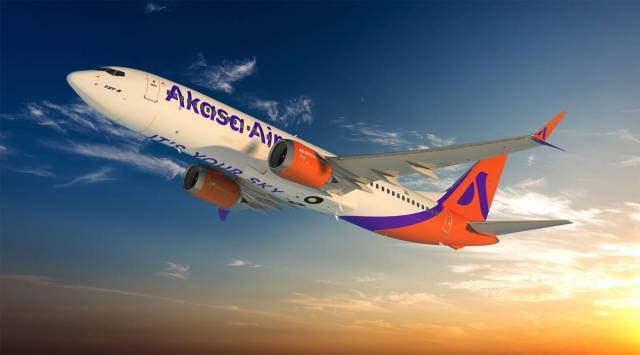 In August, Akasa Air’s market share (by passengers carried) declined to 4.2 per cent from July’s 5.2 per cent, pushing it below SpiceJet in the pecking order of domestic carriers. (File image)


 Share


