This is a rare gem of a book. The changing, and, at times, unchanging relationship of New Delhi with the states and peoples of the Northeast have rarely found so thoughtful an analyst. While grappling with contentious issues of present politics, Sanjib Baruah provides depth, context and perspective.
Assam looms large in the history and future of the region, and not only because it accounts for nearly 70 per cent of the population. Earlier, the Lushai and Naga Hills were part of unified Assam, as were the areas which were made part of the new state of Meghalaya in 1972. The author reminds us of how the outer perimeter of the Raj included princely states, and two, Manipur and Tripura, had agents of the Crown who reported to the Governor of Assam. In the 1950 Constitution, the head of the state of Assam retained special powers in the Sixth Schedule areas. Here, the older imperial power structure in the hill and tribal areas was grafted onto a republican constitutional system.
Assam was, of course, critical in economic terms, for within a decade of wresting it from the Burmese in 1826, it became a resource frontier. The author places the socioeconomic landscape and politics in a wider context. Tea gardens were carved out of forests, and planters brought in labourers from central India, with the indenture system prevailing till as late as 1926. Soon after, the boom in jute prices led to the induction of Bengali Muslim cultivators into the plains and lowland regions. At the same time, over half of Assam consisted of hill and forest tracts whose populations were classified as tribal, and were under different kinds of jurisdiction such as Excluded or Partially Excluded Areas.
This would make for an explosive mix by the 1930s. The question of who is or is not Asomiya has been contentious ever since. Baruah is at pains to show that identities were often in flux. Sylhet was part of the province from 1874, but ceded to Pakistan in 1947. Being better educated, Sylheti Hindus staffed many government jobs and became a major force, in demographic terms, in the Barak valley. Yet, in Assam as a whole, many Miya Muslims reported Asomiya as their mother tongue in the 1951 census. Unlike anywhere else in post-1947 South Asia, divides on the lines of language and religion did not overlap, though they could be as contentious.
Assamese fears of cultural extinction find a sympathetic ear, but the author is careful to draw attention to two important trends. In dealing with Naga and Mizo aspirations, for indifference and closed-mindedness, power-brokers from Assam were no match for the mandarins in New Delhi. Further, there was room for more plural views of who could be Asomiya, an issue raised by the Bodos and Dimasa peoples, then and now.
 In the Name of the Nation: India and its Northeast
Baruah’s work stands out for this interplay of levels. Much of what we take as given is a product of history. The very term ‘Northeast’ arose as an unintended consequence of Partition. But it had deeper roots in deeply racial ideas like the ‘Mongolian fringe’, a term used by Olaf Caroe (Indian foreign secretary during World War II and governor of the North-West Frontier Province), and in notions of frontiers, strategic and protective, so beloved of British governors. The persistence of similar terms and concepts in independent India is deeply disconcerting.
Faced with Naga assertion, governor BK Nehru, an outstanding diplomat and close confidante (and relation) of prime minister Indira Gandhi, was almost dismissive. His memoir Nice Guys Finish Second (1997) is quoted here with telling effect. How could a people numbering a few hundred thousand have such aspirations, he asked. This view was to find an echo in 2001 in Lt Gen SK Sinha, then governor of Assam. While Baruah takes care to show Nehru himself was far more attuned to aspirations, he also shows a continuity in policies of ad hoc concessions alternating with the use of military and paramilitary force.
The institutionalisation of military powers since 1958 raises larger questions beyond the region. The Armed Forces (Special Powers) Act, controversial even when enacted (1958), not only stays on the statute book but shows a continuity, Baruah writes, “from Nehru to Modi.”
If there is a quibble, it is with the limited attention given to the role of World War II in militarising the larger region. The Naga Hills and Manipur, as well as much of Burma, were battlegrounds for the Allies and the Japanese. It is no coincidence that the Kachins, Karens, Manipuris, Kukis and Nagas, among others, played a key role in the war. Their changing aspirations had far-reaching consequences for the successor states of India and Burma.
The Northeast is more than a term, it is a word that connotes relations of power and hierarchy. What is distinctive here is the careful attention given to the racial dimension. Sadly, this has been most evident in recent years in metropolises like Bengaluru and Delhi. It is as much about ethnic stereotyping as about privileging one set of looks, customs or habits as more authentic and national. This book most emphatically treats immigration as a serious issue, but any surgical move to deprive many of rights is fraught with peril. No wonder the Citizenship (Amendment) Act has provoked such widespread protest in Assam.
Issues of dignity and justice apart, drawing a sharp line only opens up the scope for more such divisions. This work walks the fine line between being sensitive to group identity and being deeply attentive to issues of individual choice and freedom – rare in practice, but well worth the effort. In the search for peace and dignity, a wider sense of history stays with the reader, for this is a work that has salience well beyond the Northeast, and even India.
(Mahesh Rangarajan teaches history and environmental studies at Ashoka University)

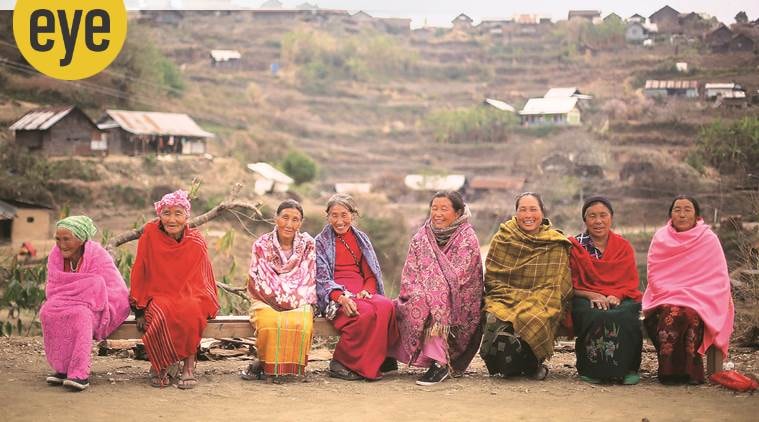 A file photo of women in Lunghar village of Ukhrul district, Manipur, taking a break as they trek home after casting their votes in the 2019 general elections. (Source: Express Archive)

 In the Name of the Nation: India and its Northeast

 Share


