India has world-class writers you’ve not read. Can ‘Hyphen’ change that?

The Kannada writer and author of 'Ghachar Ghochar' has launched a journal, publishing house and digital platform to bring Indian-language writing to a global readership

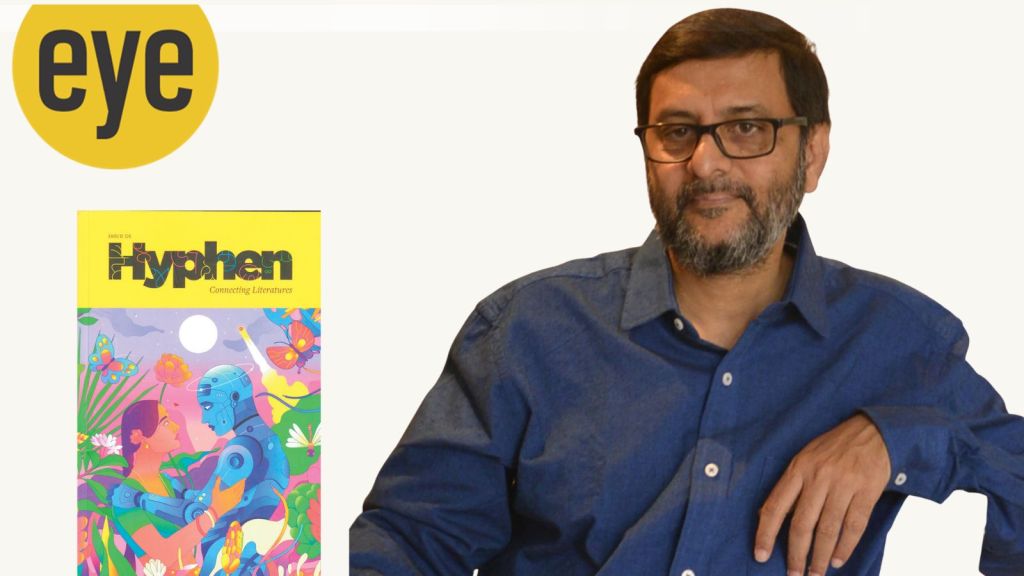
Vivek Shanbhag has launched Hyphen: a literary journal, publishing house, and digital platform rolled into one.Vivek Shanbhag has launched Hyphen: a literary journal, publishing house, and digital platform rolled into one.

Vivek Shanbhag has a suggestion on how translations ought to be read — simply as literature. “We read Russian or Latin American literature as literature, even though much of it reaches us in translation,” he says. “We should do the same with writing from Indian languages.”

The Kannada novelist and playwright has some authority on the subject. His 2013 Kannada novella Ghachar Ghochar, translated into English by Srinath Perur in 2015, travelled far beyond the language in which it was written, finding readers who encountered it as a work of literature in its own right. The book was longlisted for the International Dublin Literary Award in 2017, was a finalist for the LA Times Book Prize the same year, and won Perur the Sahitya Akademi Translation Prize for English in 2020.

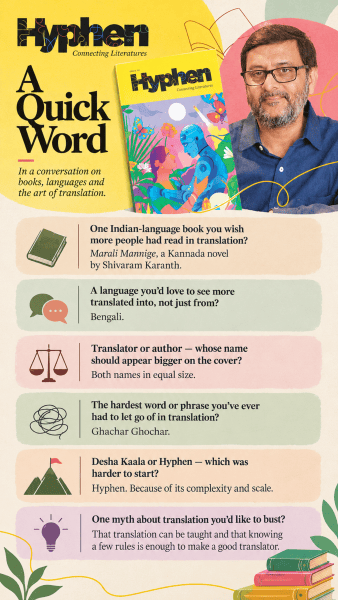
Now Shanbhag, 64, wants to make that journey possible for more writers. His answer is Hyphen: a literary journal, publishing house, and digital platform rolled into one that intends to bring Indian-language writing into a wider conversation.

Vivek Shanbhag’s Hyphen. Vivek Shanbhag’s Hyphen. (https://the-hyphen.in/)

Shanbhag insists that Hyphen did not arrive as a sudden inspiration, that it grew out of conversations that his team had been having with “literary friends in Kannada and other Indian languages”. “Hyphen was not an epiphany,” he says, “It is an idea that has grown over decades, born out of a need to understand how writers in Indian languages are responding to the political, social and economic changes, larger concerns and conflicts of our times.”

Much of Hyphen’s DNA can be traced to Shanbhag’s seven years editing Desha Kaala, the Kannada literary magazine that introduced readers to Tamil, Hindi, Bengali and Marathi writers including Jeyamohan, Uday Prakash and Meena Kandasamy. That editorship, he says, “made me realise two things. First, the diversity of styles and traditions across Indian languages is extraordinarily rich and distinctive. Second, discovering these writers is difficult when one cannot encounter their work first-hand.”

The process of scouting new work for the magazine was always “a long and pleasurable journey” — the team “invariably discovered unexpected gems along the way.” But it was not without its share of frustrations. Some of the writers Desha Kaala championed took decades to reach English-language readers. “Imagine how much richer our literary conversations would have been if these works were available in English 20 years ago, when they first appeared in Desha Kaala,” says Shanbhag.

Hyphen, in effect, runs the same experiment in the opposite direction — except its target language is not Kannada but English, and its intended audience is not one linguistic community but the larger world. “As direct translations between Indian languages have steadily declined, English has become the most effective way to access the literature of other Indian languages,” he says.

Story continues below this ad

The scale of the ambition explains why Hyphen exists as three institutions rather than one, all housed under the Bahuvachana Trust. “Hyphen’s objective is to offer a fuller literary experience through these distinct ways of engaging with readers,” says Shanbhag.

The print journal, he explains, brings together “a rich diversity of writing, allowing readers to explore and reflect at their own pace,” while the website adds articles, book reviews, poetry, fiction, plays and interviews through the week.

The publishing house, meanwhile, takes on the longer, slower work of bringing full-length books into English and “places them within a larger publishing ecosystem”. “No previous initiative has attempted to bring India’s diverse literary traditions together on this scale and place them within a shared global conversation,” says Shanbhag.

Hyphen launches amid unusual global attention to Indian-language writing — Geetanjali Shree’s Tomb of Sand, translated into English by Daisy Rockwell, won the International Booker Prize in 2022, the first novel translated from Hindi to do so; Banu Mushtaq’s Heart Lamp, translated from Kannada by Deepa Bhasthi, won it in 2025.

Story continues below this ad

But Shanbhag is wary of mistaking a prize cycle for lasting change. Awards illuminate their winners, he says, but that attention becomes durable only when readers have access to a range of writers; when it enables Indian-language authors to enter literary conversations on their own terms, rather than being wheeled out periodically as translation’s success stories.

There are, he insists, “many world-class writers working in Indian languages who deserve to be read” for their ideas, worldview and craft. Hyphen’s task is to make sure readers finally get the chance.

Paromita Chakrabarti is Senior Associate Editor at the  The Indian Express. She is a key member of the National Editorial and Opinion desk and writes on books and literature, gender discourse, workplace policies and contemporary socio-cultural trends. Professional Profile With a career spanning over 20 years, her work is characterized by a "deep culture" approach—examining how literature, gender, and social policy intersect with contemporary life. Specialization: Books and publishing, gender discourse (specifically workplace dynamics), and modern socio-cultural trends. Editorial Role: She curates the literary coverage for the paper, overseeing reviews, author profiles, and long-form features on global literary awards. Recent Notable Articles (Late 2025) Her recent writing highlights a blend of literary expertise and sharp social commentary: 1. Literary Coverage & Nobel/Booker Awards "2025 Nobel Prize in Literature | Hungarian master of apocalypse" (Oct 10, 2025): An in-depth analysis of László Krasznahorkai’s win, exploring his themes of despair and grace. "Everything you need to know about the Booker Prize 2025" (Nov 10, 2025): A comprehensive guide to the history and top contenders of the year. "Katie Kitamura's Audition turns life into a stage" (Nov 8, 2025): A review of the novel’s exploration of self-recognition and performance. 2. Gender & Workplace Policy "Karnataka’s menstrual leave policy: The problem isn’t periods. It’s that workplaces are built for men" (Oct 13, 2025): A viral opinion piece arguing that modern workplace patterns are calibrated to male biology, making women's rights feel like "concessions." "Best of Both Sides: For women’s cricket, it’s 1978, not 1983" (Nov 7, 2025): A piece on how the yardstick of men's cricket cannot accurately measure the revolution in the women's game. 3. Social Trends & Childhood Crisis "The kids are not alright: An unprecedented crisis is brewing in schools and homes" (Nov 23, 2025): Writing as the Opinions Editor, she analyzed how rising competition and digital overload are overwhelming children. 4. Author Interviews & Profiles "Fame is another kind of loneliness: Kiran Desai on her Booker-shortlisted novel" (Sept 23, 2025): An interview regarding The Loneliness of Sonia and Sunny. "Once you’ve had a rocky and unsafe childhood, you can’t trust safety: Arundhati Roy" (Aug 30, 2025): A profile on Roy’s recent reflections on personal and political violence. Signature Beats Gender Lens: She frequently critiques the "borrowed terms" on which women navigate pregnancy, menstruation, and caregiving in the corporate world. Book Reviews: Her reviews often draw parallels between literature and other media, such as comparing Richard Osman’s The Impossible Fortune to the series Only Murders in the Building (Oct 25, 2025). ... Read More


Advertisement
Loading Recommendations...
Advertisement
Advertisement
Latest Comment
Post Comment
Read Comments