


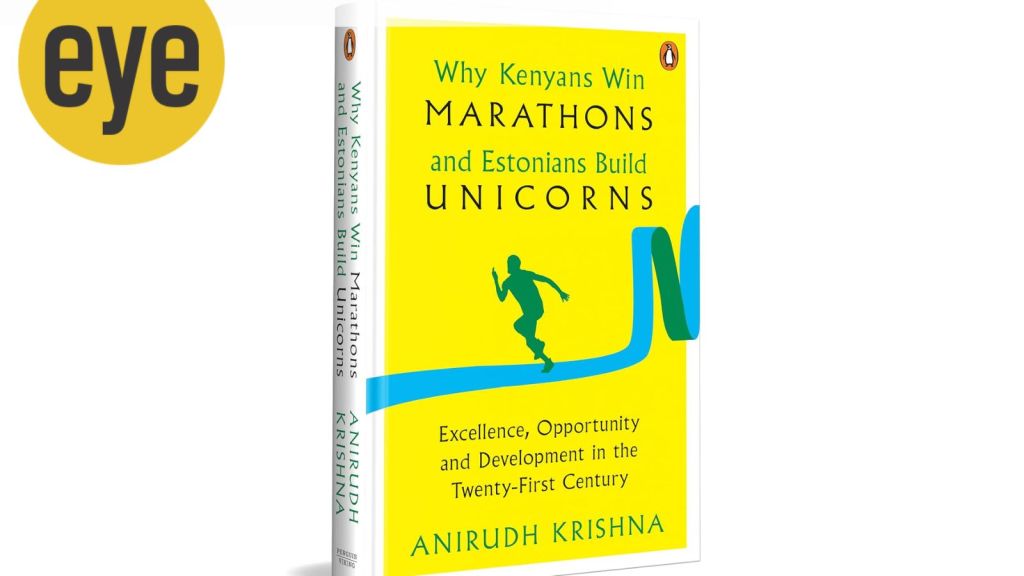
 Why Kenyans Win Marathons and Estonians Build Unicorns: Excellence, Opportunity And Development In The 21st Century. (Credit: Penguin Random House)
Anirudh Krishna had arrived a few minutes early for a lecture he was due to give to undergraduates at Duke University when he found himself drawn into a conversation about Usain Bolt, who had recently won a race. As the students continued talking, the conversation led to a deeper revelation: Bolt was not an exception. Jamaica, in fact, had a remarkable record in sprinting. The reasoning came quickly: genetics, geography and culture, none of it convincing.
Krishna delivered his lecture as planned, but the question stayed with him. “How can a country with just three million people produce a succession of the world’s fastest runners?” he recalls asking himself.
It set him off on a decade-long inquiry. The result is his latest book, Why Kenyans Win Marathons and Estonians Build Unicorns: Excellence, Opportunity and Development in the 21st Century. With the help of research assistants and students, Krishna began mapping the various flows of excellence, looking for patterns and cases he could examine further.
Some of the possibilities were unusual. “There were some exotic cases, for instance, of female lion tamers in Egypt,” he says. Eventually, he narrowed the list to a handful of cases, with Jamaica an obvious choice.
Jamaica’s case suggested that genetics alone could not explain its success. “…after gaining independence in 1962, Jamaica produced only a patchy record of international performances for more than three decades,” he says. Its dominance emerged much later, suggesting that something else had changed. His research shows that, over 40 years, Jamaica built not simply a cohort of athletes but an ecosystem capable of discovering and nurturing talent.
The process begins at the grassroots level. Every school on the island hosts an annual athletics meet as part of the calendar of the Jamaican Athletics Federation. The journey culminates in the high-school championships, universally known as the Champs, and one of Jamaica’s biggest sporting events. For four days, the country effectively shuts down and future Olympians are identified. “What distinguishes Jamaica from many other countries is what happens after school,” Krishna says.
Most athletes, however gifted, will never make it to the top. Without alternatives, years spent chasing sporting success can leave young people with little to fall back on. The solution lies in what Krishna calls “soft landings” — pathways that allow athletes to transition into other careers if sporting success does not materialise.
 Wrestler Sushil Kumar. Five of the country’s eight Olympic medals in wrestling up to 2024 were from the Haryana. (Express File Photo by Amit Mehra).
“There isn’t one super gene for running, or for anything. If you went looking for ace basketball players, you’d find Japan, where people are, on average, among the shortest in the world, just as you would in the Netherlands, where they’re among the tallest. But the Japanese basketball team is doing better than the Dutch one.”
How do societies create the conditions in which exceptional talent can be identified, developed and sustained? “Open access, with special measures for the less privileged, is the answer,” Krishna says.
Back home, he examines the case of wrestling in Haryana — five of the country’s eight Olympic medals in wrestling up to 2024 were from the state. The state’s akharas charge no training fees, leaving parents to pay only for their child’s nutritional and other monthly expenses. Athletes who reach a certain level also qualify for government jobs, giving them a stable career beyond competitive sport.
But, like Jamaica, he rejects the idea that genetics, geography and culture, taken together, explain Haryana’s dominance. “If you look around, you’ll find that there is wrestling everywhere. But this dense network, this ecosystem that has emerged through the combined efforts of civil society and the government in Haryana has not been replicated anywhere else in the country.” A common thread across these cases, he says, is that no single institution built or controlled the entire ladder.
Krishna’s book is a reminder that governments can create the conditions for excellence, but lasting ladders depend on a wider network of universities, clubs, federations and civil society actors.