3 min readUpdated: Sep 20, 2026 08:02 PM IST
In the spirit of “looksmaxxing,” American dictionary Merriam-Webster has given itself a 1,400-word “glow-up,” adding entries from food, social media culture, technology, and the words we use to describe our feelings and relationships.
Some of the words that articulate feelings, relationships, anxiety and quirks of the mind are:

📌 Sunday scaries: Does a feeling of anxiety or sadness creep over you on Sunday, a realisation that the weekend is almost over? Your diagnosis is: you are suffering from a bad case of Sunday Scaries. The slang has been around since 2013, but the feeling surely predates it.
In a sentence: Forget Monday Blues, my son has a bad case of Sunday Scaries from putting off his work until the last day.
📌 Copium: Merriam-Webster categorises this new entry, a blend of ‘cope’ and ‘opium,’ as slang, and defines it as “avoidance, denial, or minimisation…imagined as a narcotic.”
In a sentence: Putting off Sunday Scaries with an unhealthy dose of copium might not be the best idea.
📌 Crashout: Merriam-Webster has updated its entry to include the meanings, “a mental or emotional breakdown,” or “an emotional outburst or tantrum.”
Story continues below this ad
In a sentence: I have been tiptoeing around Ramesh after his crashout when he learned he had been passed over for promotion.
📌 California sober: It refers to a person using marijuana and/or alcohol but abstaining from other drugs such as cocaine or methamphetamine.
In a sentence: Thomas is on copium if he says he is six months sober—California sober, maybe?
📌 Cuffing season: The word “cuffing” comes from African-American English. It refers to romantic partnerships and was popularised by rap and hip-hop music. Cuffing season refers to a sociological trend in which people look for a short-term romantic partner to spend the colder months of the year with. The phrase was first recorded in 2009.
Story continues below this ad
In a sentence: For many, cuffing season is a way to stave off depression.
Representational image to depict new words added to Merriam-Webster’s dictionary. (Generated using AI)
📌 Uncanny valley: This word describes the revulsion evoked by the imperfect, lifelike quality of something that simulates a human, such as a doll, robot, AI-generated image or voice, or computer-animated character.
The term comes from Japanese roboticist Masahiro Mori’s 1970 hypothesis that humans’ affinity for objects that simulate human characteristics sharply drops and is replaced by a feeling of eeriness. The phenomenon is shown on a line graph that depicts the “valley” of the sharp drop and subsequent rise in affinity.
In a sentence: With AI slop flooding the internet, we get pushed further into an uncanny valley.
Story continues below this ad
📌 Mandela effect: This term comes from numerous people who misremembered that South African president Nelson Mandela died in prison. It is a “phenomenon in which many people collectively misremember a specific fact, event, or detail consistently.”
In a sentence: All of us swore Sunday Scaries was a Gen Z invention, but as it turns out it is just the Mandela Effect, because older generations have been dreading Mondays just as long.
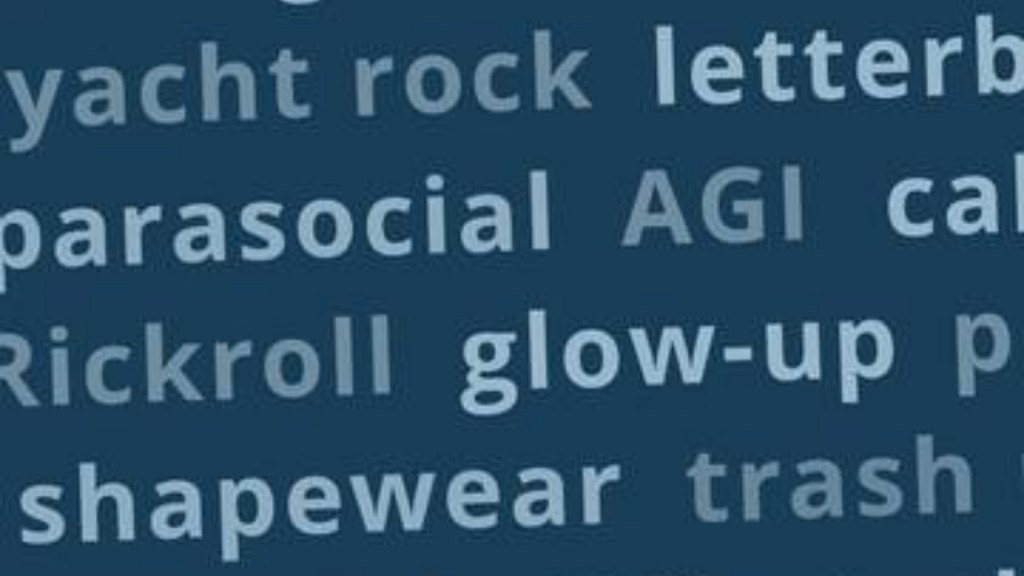
Other words added to the dictionary include whack-a-mole, vibe coding and AGI (artificial general intelligence), parasocial, Rickroll, meme coin, promposal, letterboxing, and edible items such as superfood, cake pop, shishito, and bao bun.




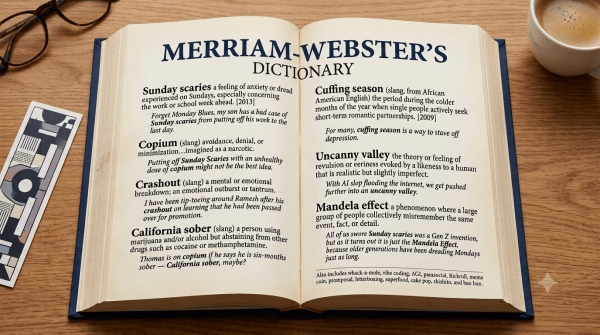 Representational image to depict new words added to Merriam-Webster’s dictionary. (Generated using AI)
