4 min readSep 28, 2026 06:15 PM IST
First published on: Sep 7, 2026 at 10:13 AM IST
Welcome to Quick Verdict, a fortnightly column where every book gets a hit or miss.
This week: Why Satoshi Yagisawa’s More Days at the Torunka Cafe serves more of healing-fiction; How Antara Mukherjee’s Beyond Our Births uses one girl’s search for identity to hold up a mirror to Bengal’s fraught politics of belonging; and how Pia Ghosh-Roy’s And I Am the Arrow turns a family haunting into a study of the wounds we pass down.

Satoshi Yagisawa’s More Days at the Torunka Cafe
Verdict: MISS
In a market glutted with Japanese and Korean ‘healing fiction’, Satoshi Yagisawa’s More Days at the Torunka Cafe, newly translated by Eric Ozawa, is a sleep-inducing, inert placebo. The novel follows the same tired recipe: World-weary customers, each nursing some private wound, serendipitously drift into a humble cafe that dispenses epiphany with a side of coffee. Where Toshikazu Kawaguchi’s Before the Coffee Gets Cold allowed readers to reckon with their regrets through a time-travelling cafe and Hiro Arikawa’s The Travelling Cat Chronicles had readers sobbing over the loyalty of its feline narrator, Yagisawa’s story is an anaemic, formulaic sequel lacking heart, written only to tap into the popularity of its predecessors. The stories drag, and the dialogue is utterly bland. It fails to replicate the quaint charm of his Morisaki series. Those expecting a balm for the agitated soul or a rendezvous with their inner selves through the book will be disappointed.
(Reviewed by Aishwarya Khosla)
Beyond our Births by Antara Mukherjee
Verdict: HIT
Antara Mukherjee’s debut novel, Beyond our Births, comes with strong socio-political commentary on how the circumstances of birth shape the trajectory of one’s life. The Kolkata-born writer sets her novel in the ’90s, when Nimki, an orphan abandoned at the India-Bangladesh border at five years old, finds refuge with the Senguptas in Kolkata. But finding refuge does not mean belonging; Nimki is treated as domestic help. She yearns for love from the family matriarch Bina Ma, who works with an NGO for displaced women and children. Juxtaposed against Nimki’s struggles is the life of Ira, the Senguptas’s daughter. After Ira becomes the target of sexual assault, the family decides to move out of the country for a fresh start. The novel deals with identity. Nimki discovers that she is not only Muslim but that she was abandoned by her birth family in Bangladesh. Her journey takes off when she leaves India to seek them. Read against the backdrop of the recent SIR in West Bengal, where more than 90 lakh names were deleted from the rolls, many of them Muslim, Beyond Our Births is a poignant first book.
(Reviewed by Reva Thakkar)
Pia Ghosh-Roy’s And I Am the Arrow
Verdict: Hit
Mishu grew up in her grandmother’s story-filled presence. As an adult, with her New York life unraveling, she returns home to Kolkata, when her grandmother, Niyoti, slips into a coma. Set in Calcutta, London and New York, Pia Ghosh-Roy’s debut novel And I Am the Arrow follows three generations of women from the Chatterjee family — Mishu, her mother Ira, and her paternal grandmother Niyoti — and their servant Bani as they navigate their complex relationships, even as they find themselves interacting with the spirit of a dead man, who refuses to be called a ghost.
The novel reflects on the intergenerational trauma passed down, intentionally or unintentionally, and the scars left behind by the people one loves. It uses multiple points of view to unfold the narrative, offering a glimpse into each character’s mind and keeping the story engaging. These are women who are flawed and make hasty, life-altering decisions, just like any of us. A recommended read to explore not just the Chatterjee women’s family dynamics, but also to introspect on your own.
(Reviewed by Anusree K C)

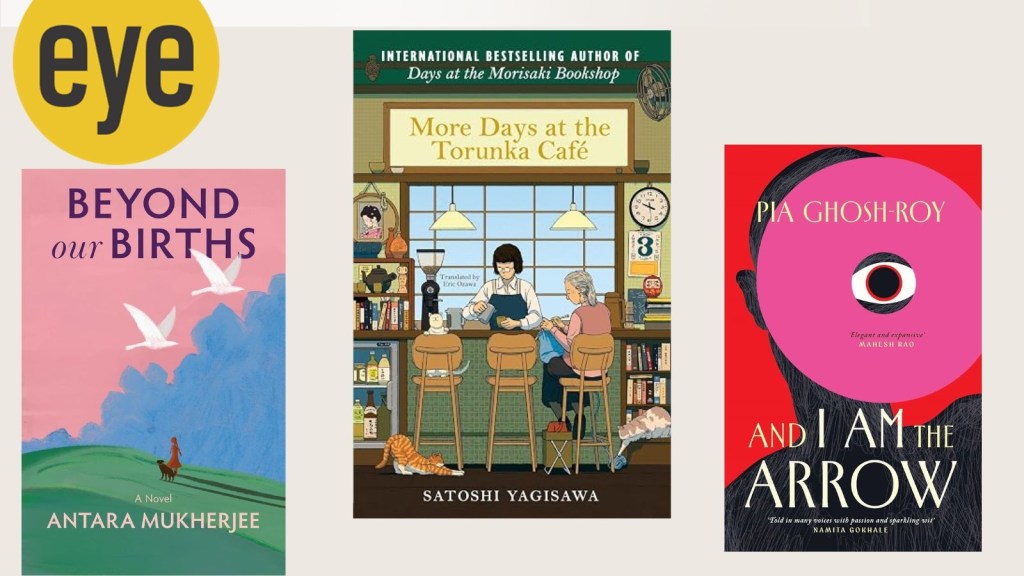 Satoshi Yagisawa's More Days at the Torunka Cafe, Antara Mukherjee's Beyond Our Births, and Pia Ghosh-Roy's And I Am the Arrow reviewed.


 Share


