


Journalism of Courage
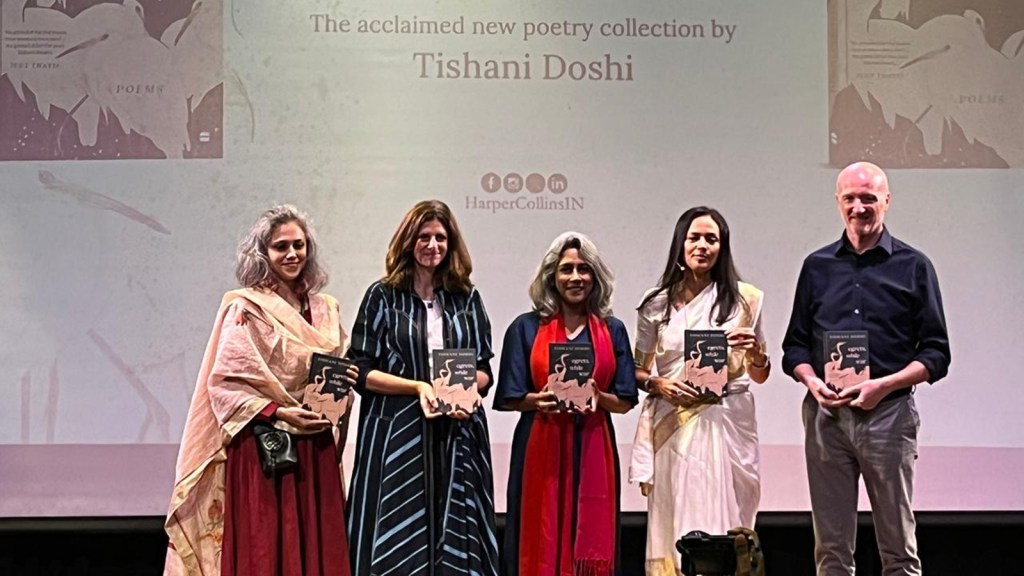 Tishani Doshi's Egrets, While War.
(Written by Shreyoshee Palit)
People keep predicting the death of poetry, but poet Tishani Doshi believes that human beings never really stop needing it.
“No matter how many people keep writing its obituary, when it comes to it, we always turn to poems,” Doshi told novelist Anuradha Roy during a conversation about her latest anthology, Egrets, While War. “When people die, when we were going through Covid, during marriages, births, and other transitional moments of life, one looks for a poem.”
It is a curious contradiction as poetry is often treated as one of the more intimidating literary forms: difficult, obscure, less immediately useful than prose. Yet, as Doshi pointed out, it repeatedly finds its way into moments when ordinary language proves insufficient.
Doshi’s debut collection, Countries of the Body, won the Forward Prize for Best First Collection in 2006. Her subsequent collections, including Girls Are Coming Out of the Woods and A God at the Door, move between the body, gender, violence, nature and mortality. Her work as a dancer with the late choreographer Chandralekha has also shaped her understanding of poetry as something physical and embodied.
Roy asked Doshi about a poem in which she imagines herself as an “immortal mosquito”, buzzing insistently in a reader’s ear. Doshi admitted she had once thought of herself in almost evangelical terms, trying to persuade readers not to fear poetry.
Since then, she has been more willing to acknowledge what makes it difficult. Poetry, she said, is not simply words and language: “It is spell-making, it is prayer, it is mysterious.” Its meaning does not always arrive in a neat package. A poem can move someone through the combination of sounds before the reader has worked out exactly what it means, much as a song in an unfamiliar language can alter something inside the mind.
That initial unknowability, Doshi suggested, should not necessarily count as a flaw. Poetry asks readers to slow down rather than rush towards an answer. “You have to throw meaning off,” she said. In that sense, the forbidding nature of poetry may also explain its endurance. Unlike a novel, it does not require a sustained narrative world. It can remain unresolved.
Egrets, While War is a collection preoccupied with things that resist resolution: environmental destruction, war, extinction, ancestry, and grief. Roy quoted one of Doshi’s poems referencing Gisèle Pelicot, and asked how her work responds to contemporary catastrophes that make the news every day. Doshi said she indulges in a “combination of time zones”, the past and the present, in her poetry.
“I think, primarily, I just feel the present to be overwhelming. So much of poetry is elegiac; it is a mourning, it is a grieving, about climate, about war.” She refuses to treat the past as something that exists in isolation, writing instead in a way that creates a conversation between these time zones. “I think that for me as a poet, it’s impossible not to respond to the news, because I’m not living under a rock. I feel everything very strongly.”
That ability to collapse time lies at the centre of her understanding of the form. Doshi spoke of her fascination with archaic words and forgotten meanings, part of the same impulse that drives her poetry. She wants to retrieve words that have fallen out of circulation, just as her poems retrieve extinct species, ancestral stories and older ways of seeing. In Egrets, While War, the past is not an escape from the present; it is another way of looking at it.
Perhaps that is why people keep returning to it. A poem cannot stop a war, reverse an extinction or repair a damaged planet, but it can preserve attention. It can make the ordinary strange again, make the past speak to the present, give shape to grief without reducing it to an explanation. “There was a story in The Guardian, maybe last week, saying that the sales of poetry in the UK have never been as wonderful as right now, because many more people seem to be buying and reading poetry than ever before,” Roy mentioned, to which Doshi replied: “Hallelujah!”
(The author is an intern with The Indian Express)