5 min read
© The Indian Express Pvt Ltd



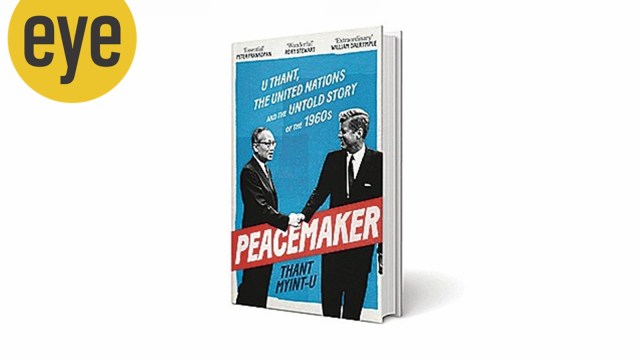 Peacemaker is the biography of U Thant (Amazon.in)
The United Nations is today an object of derision. Yet, one of its key architects, the incomparable Burmese statesman U Thant —Secretary-General from 1961 to 1971 — has been largely airbrushed out of history. Thant Myint-U’s brilliant, riveting and historically well-judged biography of his grandfather is a double act of recovery. It restores to view a college dropout and Burmese schoolteacher who became a colossus among international diplomats, navigating every major crisis from Congo to Cuba and Vietnam to Gaza.
The book’s power lies in how contemporary the crises Thant managed now feel — the forgotten UN mediation in the India-Pakistan war of 1965, the deep historical roots of Gaza and the crisis of the UN itself. It is also a tribute to an ideal of global politics. For all its impotence, before the unjust architecture of global power embodied in the Security Council, the United Nations remains the best expression of the decolonisation project — a forum where the voices of nearly 200 self-determining nations can still find articulation. Thant was prescient in seeing the UN as an institutional embodiment of decolonisation, and in consolidating that idea at a critical moment in world history.
The Secretary-General’s position is an impossible one. He has no power. He is meant to be neutral, which in effect means everyone has reason to be annoyed with you. The UN is dependent financially on the big powers. The Secretary-General had immense prestige burdened by the weight of expectations. Thant’s reign as Secretary-General is a remarkable story against the odds. There is immense triumph in the early days. Thant’s deft diplomatic skills, personal relationships and sense of history institutionalise a fledgling organisation that could have very nearly met its ruin in the late 1950s. But the UN also established its credibility in its handling of the Congo crisis where, for all its faults, the UN resisted the machinations of the European powers. Peacemaker makes the striking historiographical claim that the UN’s role and Thant’s diplomacy played a crucial role in resolving the Cuban Missile Crisis, which brought the world to the brink of nuclear war. The story of these two crises is told with immense verve, full of diplomatic and military drama. But the key, particularly in the Cuban Missile Crisis, was
the willingness of both superpowers to use the UN.
John F Kennedy, in particular, comes across as seeing use for the UN. And Thant manages to establish his credibility as a good-faith interlocutor, upholding the core mission of the UN, which is to keep the peace in a world of nation-states. The second act is more tragic. The UN did not falter because of the Cold War but because of the American fear of losing face in Vietnam and, later, the Gaza crisis. As Thant’s own account shows, there were multiple opportunities to resolve the Vietnam crisis, all blocked by American reluctance.
Under Lyndon B Johnson, unlike Kennedy, hostility to the UN deepened and Thant’s diplomacy failed. The Six-Day War was another disaster, alienating both Israelis and Arabs, and by the late ’60s, the euphoria of decolonisation had faded, leaving the UN diminished. The contradiction between an institution with prestige but no power, few resources but full expectations, was beginning to pile up.
By the ’70s, even Thant was being forgotten and, with him, the history of the global south in forging a new world order. Peacemaker has a novelistic gift in recreating the political drama of the 1960s, full of vivid characters wrestling with the uncertain intentions of their political rivals. But this is not a fatalistic story. It is a kind of realist paean to the ideals of diplomacy and a vanishing breed of deft internationalists. Thant and his team, which included Ralph Bunche and Brian Urquhart, but also two names who should be better known in India — his military advisor Indrajit Rikhye and Chief of Staff CV Narasimhan — were, in their own ways, world makers, trying to institutionalise snippets of peace in a hostile world. There are also moments of political sanity, where the Great Powers actually see the value of the UN, and the disillusionment with the project of decolonisation has not yet set in, making the ideals of the non-aligned world a serious global force. The book is an antidote to the cheap condescension of posterity that has been heaped on the idea of the UN. Thant’s story is empowering even as he is, in the end, overwhelmed by the odds.
Pratap Bhanu Mehta is Contributing Editor at The Indian Express