


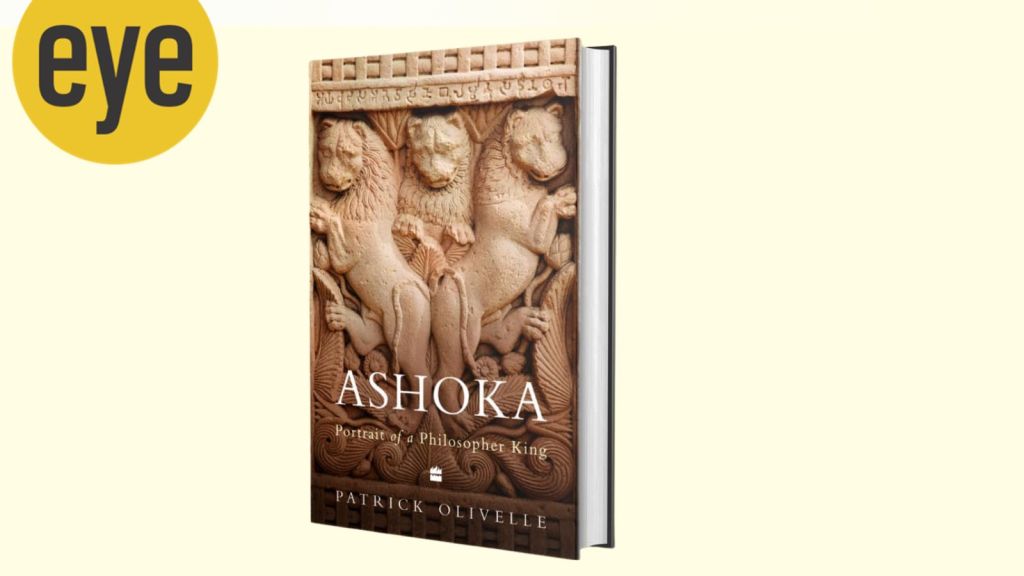
 Patrick Olivelle’s Ashoka: Portrait of a Philosopher King.
Imagine a literal, corporeal elephant in the room: You might make a valiant stab at not talking about it, but much of what you do will inevitably be determined by its presence; at the very least, you will have to avoid bumping into it. Reading Patrick Olivelle’s Ashoka: Portrait of a Philosopher King left me with a similar lingering thought — how much of Indian history and thought in the centuries after Ashoka was a reaction to the Mauryan emperor, however much the Brahmanical authors may have avoided discussing him directly?
Relying on Ashoka’s own inscriptions, Olivelle draws a compelling portrait, and what we see is an extraordinary, exuberant personality, threatening to burst out of the pillars on which his words are engraved. This individuality is in stark contrast to later kings with their generic, vainglorious boasts. Here was a writer who promised to “always keep writing more.”
Here was a man with the temerity to lecture the Sangha on Buddhism, just a few years after becoming a Buddhist himself. Here was a king with the imagination to try things never thought of before, to build a shared moral universe for his subjects, an ecumenical dharma that looked beyond Buddhism to encompass all pasandas or religious traditions.
There’s something elegiac in Olivelle’s account of the unravelling of Ashoka’s legacy that makes one wonder what might have been. As he points out, there is no reference to caste in Ashoka’s inscriptions; the Brahmanas and Shramanas are envisaged only as groups of “religious professionals.” Could history have progressed along a better path if Ashoka’s ecumenism had taken root?
What Olivelle calls the “exceptionalism” of the Brahmanas, and their consequent rejection of ecumenism, may have helped scupper the project. The dharmasutra-dharmashastra tradition went on to articulate the Brahmanas’ own varna-based ideals, a vision antithetical to — and possibly responding to — that of Ashoka, starting with the Apastamba Dharmasutra, which may have been close in time to the emperor.
The epic heroes Rama and Yudhishthira also began to be held up as ideal kings devoted to the Brahmanas (brahmanya); Olivelle quotes James Fitzgerald’s assertion that Yudhishthira was “designed as a refutation, or at least a rebuttal, of the emperor Ashoka.” In this connection, one might also recall the argument made by V S Sukthankar, the general editor of the critical edition of the Mahabharata, that the epic was for a long time in the custody of Brahmanas of the Bhrigu gotra, who added their own “Bhargava material” to the text, including the references to Bhargava Rama or Parashurama, the exterminator of the Kshatriyas.
To deny the impact of these Brahmanical ideals on social reality and caste as it evolved on the ground would be to deny the influence of ideas on history. The shastric texts have a well-documented history of being consulted and applied. Today, the best-known such text, Manusmriti, is in the eye of a storm yet again. But the memory of Ashoka invites us to imagine a world in which Manusmriti never was.