© The Indian Express Pvt Ltd
 3 min read


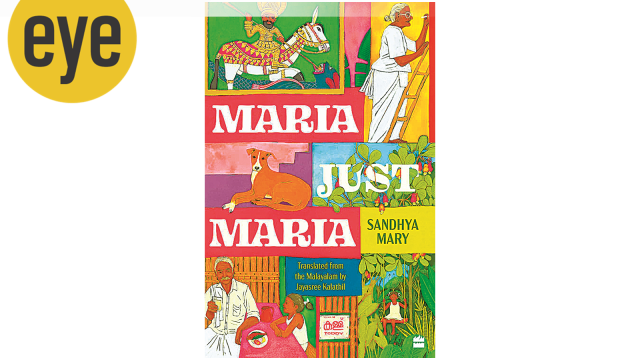 Maria, Just Maria (Source: Amazon.in)
Child psychologist Haim Ginott, in his Between Parent and Child, remarked that “children are like wet cement. Whatever falls on them makes an impression.” But what does society teach us about being human? What does it mean to be normal?
Sandhya Mary’s Maria Just Maria, translated from the Malayalam by Jayasree Kalathil, explores these questions. The beautiful cover illustration by Nupur Panemangalore helped broaden my imagination as I read the story, associating it with wet earthy floors, soft cotton and soggy banana leaves.
The story begins in a mental hospital where Maria is recovering from the weight of being labelled “mad”. Having grown up in a Syrian Christian family in Kerala, raised primarily by her grandparents and living a life “without structure or discipline,” Maria’s journey of self-discovery unfolds against a backdrop of neglect, bullying and rigid societal expectations.
We witness her whimsical childhood – with characters like a philosophical talking dog and a smart, chatty parrot — give way to a harsh life of isolation. Bullied by her siblings and ignored by her parents, she questions her place in a world that constantly imposes on her its definitions of normality. In its non-linear, dreamlike narrative, the story reflects Maria’s fragmented thoughts. The novel makes the reader pause before judging someone’s right or wrong. Maria dwells on grief, success and the cause of her madness.
As Maria interacts with others, the message becomes clear: anyone who deviates from societal norms is deemed abnormal. She reminded me of Pecola Breedlove in Toni Morrison’s The Bluest Eye, who questioned societal judgments and highlighted the impact of external perceptions on self-worth. Maria’s emotional turmoil is evident when she says, “I’ve yet to meet a child who personifies innocence, and for me, I don’t remember any feelings other than fear and hatred.”
To me, Maria’s sense of reality seems more authentic than the artificial constructs imposed on her. Her poignant question — does knowing the answers in school truly equate to intelligence? — challenges narrow definitions of success and prompts reflection on what it means to be truly “normal” or a “good human”.
Early in the novel, the narrator says, “Human life up until the age of twenty is nothing to be taken seriously. All it amounts to is the sum total of ignorance, immaturity, stupidity, and above all else, arrogance. It doesn’t matter if it is Isaac Newton, Shakespeare, or Socrates; there is no one who does not think about some idiotic thing they did before they were twenty and say ‘aiyye’ with an embarrassed laugh.” Being normal is not about scoring at the top in mathematics or excelling in the arts; it’s about being able to live one’s own age.
The author gently reminds us that caring for mental health is not as simple as curing a seasonal cold; it requires constant support and questioning of the societal labels that define and confine us.