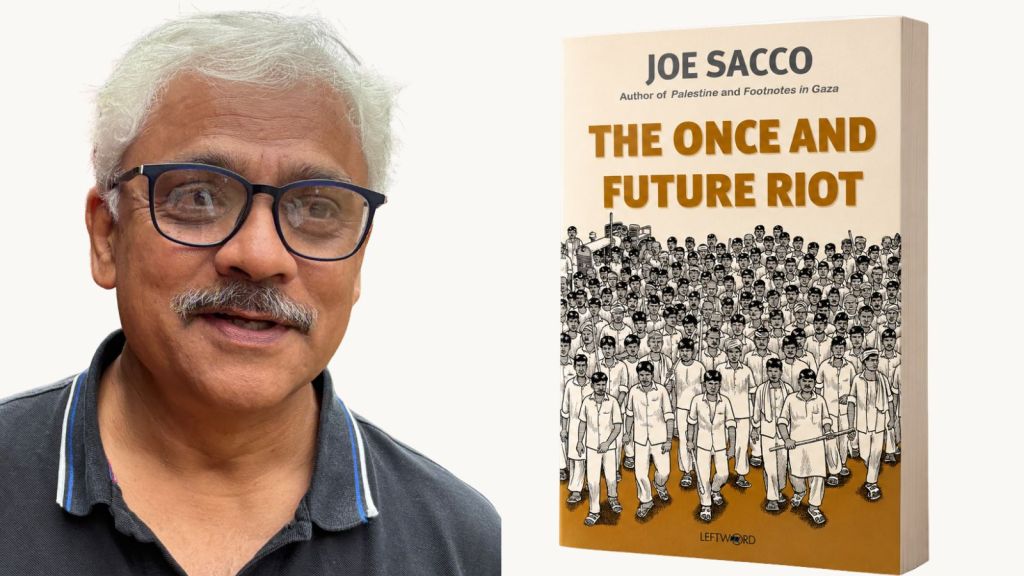
The Indian Express spoke to Sudhanva Deshpande, LeftWord Books managing editor, about the decision to publish The Once and Future Riot, whether any changes were made, and the ramifications of a Big Five publisher’s unwillingness to back its authors on the industry as a whole. Edited excerpts:
Sacco told The Indian Express that PRHI required him to “change quotes from people…including a public figure.” Have those been retained?
Sudhanva Deshpande: That was not even a conversation. Honestly. We wanted to do the book. Joe Sacco wanted us to do the book, and we did. There has been zero conversation around that. I don’t even know what changes PRHI asked for.
PRHI has now backed out of three major projects. As a publisher, what do you make of it?
Sudhanva Deshpande: The first major instance of Penguin pulling out was Wendy Doniger’s The Hindus. PRHI, instead of pursuing the case (which they would have honestly won), chose to pulp the book. Another publisher brought out the book without any changes, and there was no problem.
Other authors (Dhirendra K Jha, author of ‘Golwalkar: The Myth Behind the Man, The Man Behind the Machine’) have shared similar experiences.
So it appears to me, from the outside at least, that yes, there seems to be a pattern. What is the reason for that pattern? I cannot say.
Story continues below this ad
As a publisher yourself, do you feel a palpable pressure? Have you faced threats?
Sudhanva Deshpande: We have not heard of any pressure. Sonia Gandhi’s memoir (Belonging) is soon going to be out from another publisher. So, I am inclined to believe PRHI’s own statement that there is no external pressure.
Someone at the very top of PRHI is either extraordinarily cowardly or ideologically quite hardcore right-wing in their belief, or maybe it is both.
It appears to me, at least from the outside, that Penguin seems to be more loyal than the King.
What are the legal difficulties of pushing out a memoir? What are the checks that the legal department looks into?
Sudhanva Deshpande: In the case of Sonia Gandhi’s book, it appears extraordinary that PRHI should have taken the stand that they did, as it is a memoir by a very important political figure in India. She is known as a sober person, not someone who riles up controversy.
Story continues below this ad
Going by press reports, the points of contention are her response to something the Prime Minister said about her in public. There cannot be a legal problem with somebody defending themselves. The other things, apparently, refer to the RSS and the border issue with China. Now, those are well known and matters of public concern.
Therefore, this whole issue of “oh, it was the legal department that said to us” seems to me to be utter nonsense.
What is the impact on publishing as a whole when a big publisher gets cold feet?
It is a publisher’s job to put out books of public interest, educate the public, and contribute to public debate in a healthy way. And PRHI, by repeatedly withdrawing these books, is harming that process.
It also normalises the idea that books that are critical of the government in any way are “dangerous”, and effectively puts a target on the backs of publishers who are doing interesting, slightly edgy, slightly different kinds of books that are voices of dissent.
Story continues below this ad
Ultimately, publishing puts ideas into the world. And if we do not have a diversity of ideas, what kind of democracy are we talking about?
What is a publisher’s stance in general in case there is a defamation suit, an FIR, or any of those issues?
I obviously cannot answer for all publishers. Smaller publishers like ours are very tiny. We don’t have deep pockets; we don’t have resources. We have nothing, except we have a spine. In fact, that is the pitch that we made to Joe Sacco: ‘We will not back out. We will stand by this book, and we will stand by you.’
It is really quite disappointing to me that publishers with the resources are not willing to stand up. And I sometimes hear this—and it amuses me—“Oh, they are big so they have more to lose.” That is just not true. Small publishers are the ones that have more to lose. If we come into trouble, we will have to shut down shop. They can defend themselves, and many others will come and help them.