


Journalism of Courage
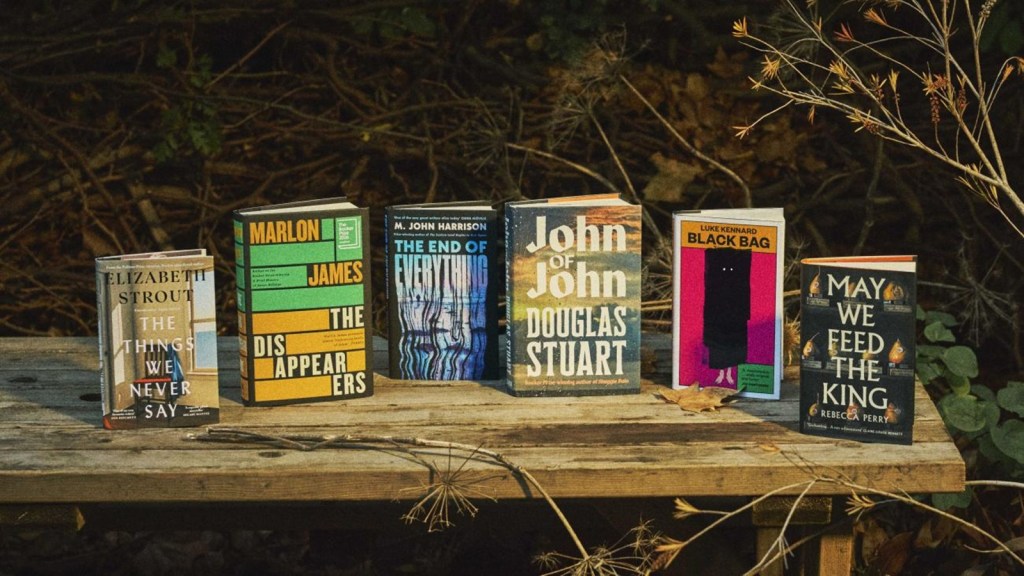 The Booker Prize 2026 shortlist. (Credit: Yuki Sugiura for Booker Prize Foundation)
A scavenger prowling a post-apocalyptic Kent coast, a reluctant medieval king, eight gay men rehearsing a play in 1980s Kingston, and an actor zipped inside a black bag for a university psychology experiment–the 2026 Booker Prize shortlist travels across space and time, from the Outer Hebrides to coastal Massachusetts.
A panel chaired by the classicist Mary Beard winnowed a longlist of 13 down to six, which includes former winners Douglas Stuart and Marlon James, and Elizabeth Strout, who has been nominated for the third time, alongside debut novelist Rebecca Perry. At 81, M John Harrison could become the oldest-ever winner of the prize.
In the wake of an unexplained catastrophe, Phillip Tennent makes a living scavenging whatever the Channel washes ashore. One day he finds an artefact that changes shape and appears to be learning how to behave like a human being, and he takes it inland to sell. Meanwhile, his aunt Marnie, a 70-year-old former artist with a capacity for sudden violence, makes her way towards London through a country where the machinery of government has all but disappeared. Harrison asks: “what happens when all of our expectations and explanations of the world become an ongoing disaster, but we still have to make a life?”
In 1988 Kingston, eight gay men are rehearsing what is billed as Jamaica’s first openly gay play when a mob attacks them, killing one. James follows the survivors across decades, tracing grief, anger, memory, the temptation of revenge and the long aftermath of violence. The novel returns to the Jamaica of James’s Booker-winning A Brief History of Seven Killings, but its starting point is an attack that was rumoured but never proven. “In Jamaica we trust rumours more than facts,” James says. The result is a story about what happens when history itself becomes something people have to reconstruct.
What would happen if university students found a man sitting silently inside a large black bag at the back of their lecture hall? Kennard turns a real 1960s psychology experiment into a strange campus novel about a struggling actor who agrees to become its human subject. As researchers observe the students around him, the absurd premise opens into a story about masculinity, art, shame and desire. Kennard says he was “more interested in the person playing black bag than the results of the study”, and that interest gives the novel its human centre.
 The Booker Prize 2026 judges – Raymond Antrobus, Patricia Lockwood, Rebecca Liu, Jarvis Cocker and Mary Beard – with the longlisted books. (Credit: Neo Gilder for Booker Prize Foundation)
Perry’s debut moves between two figures. One is a present-day curator who recreates historic palace rooms with replica food. The other is a reluctant medieval king who comes to the throne after the deaths of his older brothers. As whispers spread through court that the young ruler is unfit to govern, the curator becomes increasingly absorbed by the past she is trying to reconstruct. The two timelines converge, forcing us to ask how much we can ever know about a world that has already disappeared. Perry arrives on the Booker shortlist having won the Waterstones Debut Fiction Prize.
From the outside, Artie Dam’s life looks settled. A 57-year-old history teacher in coastal Massachusetts, he has a long marriage, good friends and a sailboat. Yet beneath that ordinary surface he is increasingly isolated. When he discovers a secret that has been kept from him, the assumptions on which his life rests begin to shift, forcing him to reconsider his marriage, family and friendships. Strout found the character in an old obituary for a man named Damm, who, she says, looked “so entirely ordinary and pleasant”.
John-Calum Macleod is 22, an art graduate and a reluctant returnee to the Isle of Harris. Back in the deeply religious community he had hoped to leave behind, he is caught between his strict Presbyterian father, John, and his outspoken Glaswegian grandmother, Ella. As old secrets and buried shame surface, they expose the silences that hold both family and community together. Stuart set out to write about “the bond between a father and son despite the deep silence between them”. The judges found in it, “unexpectedly but wonderfully”, shades of hope.
The winner will be announced on November 9, 2026, at a ceremony at London’s Old Billingsgate.