


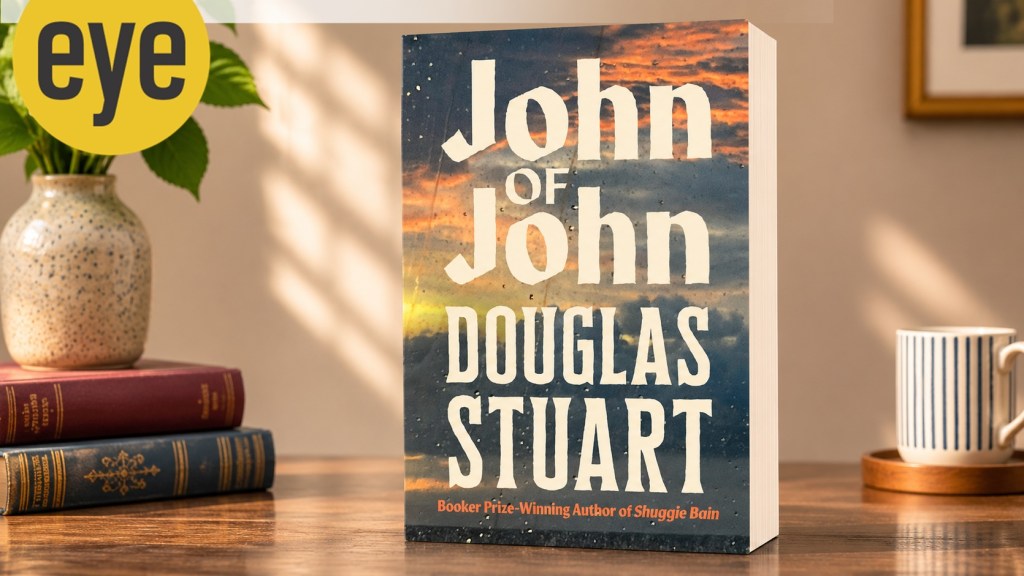
 Douglas Stuart’s John of John


There is a truth, often unsaid, about putrefied desire and how the smell of its decay worms its way into every kind of love – between siblings and friends, children and parents, even the parts of yourself that would otherwise flourish. At the end of Douglas Stuart’s John of John, it becomes clear that what we in the Subcontinent call “majboori” can become a habit of the soul, that the claustrophobia of helplessness is something we can all become comfortable with, till it either erupts in destruction or withers away a life that bleeds out in an unremarkable death.
John-Calum (Cal) Macleod, gay, unemployed and seemingly unemployable in ’90s Scotland, is summoned home by his father, John Senior. In the small, dying island town, there is nothing but the stern, Presbyterian father, the sheep, weaving and a grandmother, both tender and ailing. The relationship between father and son is mediated by religion, a sense of the family name, and Cal’s duty to both. Take one of the first things John says to Cal when the prodigal son returns – a remark about the city-returned young man’s clothes: “You look like a cross-dresser that’s thrown on a coat because he’s run out of milk.”
Cal, on his return, tries to rekindle a childhood friendship and adolescent sexual relationship with Doll. Like the returning NRI, he seems to believe that the outward immutability of the imposing cliffs in the Scottish Hebrides, the unchanging cycle of the lambing and shearing seasons, the predictability of the weaver’s task mean that the people, too, are still lifes of what he left behind. Not so, clearly, as Doll rejects his advances.
John of John, though, is not really Cal’s story. It is the stern father, and his long, secret, furtive and even tender relationship with his neighbour Innis that is at the heartbreaking centre of the novel. The long years of lies, of stolen moments and that odd mix of violence and tenderness that defines sexual love are all amplified, often in their worst parts, when those at its centre believe the religious and social lies about what their desire signifies. Stuart gives us a sense of that guilt and criminality, almost as though desire is an addiction and self-hatred a moment of clarity.
Stuart was at the centre of the Anglophone world’s literary conversation six years ago when Shuggie Bain, his debut novel, won the Booker Prize. To an Indian reader, there was something familiar – the vast gap in the way the Scottish characters spoke and thought in the book notwithstanding – in the tale of the beautiful, alcoholic, charming, abused Agnes Bain. Shuggie, in his devotion, is all but Shravan Kumar, his story at least as tragic from the parable from the Ramayana. The intimacy of that first novel, and much of his work, including short stories, since, may be because of its seemingly, at least partly autobiographical nature.
View this post on Instagram
John of John takes place far from Glasgow, and there is a vast gap, on the face of it, between Shuggie and Cal, between Shravan Kumar and the Prodigal Son. But a line connects Glasgow in the ’80s and the fictional Falabay in what seems like the ’90s. Simply put, the voice first discovered six years ago is becoming more masterful, more itself even as it expands in themes, relationships, style. Agnes was a mother who loved and could be loved, vulnerability and darkness all in one. John is the father and lover who, really, doesn’t know how to be either. Between them, and whatever comes next, Douglas Stuart is a writer that must be read.
John of John by Douglas Stuart
Picador
416 pages
Rs 999