3 min read
© The Indian Express Pvt Ltd



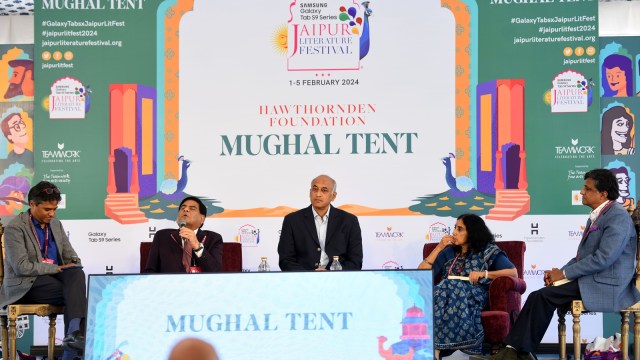 K Srilata, Debashis Paul, Justice Najmi Waziri and Anil Aneja in conversation with V. R. Ferose at Jaipur Literature Festival at Clarks Amer in Jaipur on Friday. (Express Photo by Rohit Jain)
“I think we should really not hierarchise disabilities between the ones that [we can] and cannot see, such as the one that my daughter faces. Dyslexia is as as important and sometimes even harder than a visible disability,” said K Srilata, writer and caregiver to a daughter with dyslexia, on day two here at the Jaipur Literature Festival 2024.
She was in conversation with Anil Aneja, the Head of the Department of English at the University of Delhi, former Justice Najmi Waziri, Debashis Paul, statistician and parent to a child on the autism spectrum disorder, and moderator and writer VR Feroze, about how to destigmatise disability in India.
“Accessibility is cost-intensive. It is important that budgetary allocations are made to ensure that everything is accessible [for persons with disabilities],” said Aneja.
On the legal front, Waziri defended the robustness of the Rights of Persons with Disabilities, 2016 Act, asserting that persons with disabilities have rights they are entitled to, and that advocating for them is not a matter of pity but duty.
Aneja discussed the hindrances he faced as a young person with disability, saying, “This journey has been a combination of two contradictions: resistance and negotiation. My family did not want me to study… I resisted. Today, I head the coveted Department of English at Delhi University, which is one of the top 150 departments of the world.” He also mentioned favouring the term “universal design” over “accessibility” to include people without disabilities in the conversation.
Srilata, most recently author of This Kind of Child, highlighted the need to understand invisible disabilities, saying, “There is nobody here in this audience, on this panel, who hasn’t been touched in some way or the other by the experience of disability. Disability is not something that happens to somebody else. It is probably happening to us, even as we are sitting here and talking about it because there’s always the process of aging, right?”
Paul, author of I Have Autism And I Like To Play Bad Tennis: Vignettes and Insights from My Son’s Life, talked about the difficulty of maintaining courage when a loved one is afflicted with a disability.“What gets applauded are those big wins in life… [after my son’s diagnosis] I started questioning that. It had to be about how you deal with your everyday, because the child will learn on a daily basis,” he said.
Feroze spoke on how companies can be incentivised for more inclusive design in the digital space, saying, “Apple is a classic example… They say if your products are not accessible, we are not releasing it to the market. That is part of the reason iPhones are so popular… Companies who keep accessibility at the front and centre will have a huge advantage with respect to the market share.”
sukhmani.malik@gmail.com