Jim Corbett was a colonial hunter who famously tracked elusive man-eating tigers and leopards across the Himalayan foothills in the early 20th century. However, his name survives in India to this day, not because of the fearsome beasts he hunted, but because of what he wrote.
Between 1944 and 1955, Corbett published six books that transformed his adventures in the dense Indian jungles into literary legend. Man-Eaters of Kumaon, the first and most influential of these, remains one of the best-selling and most widely read wilderness books written about India. His works have been translated into over two dozen languages, remain in circulation across generations, and continue to influence how naturalists, tourists, and general readers perceive forests and the animals within them.

Corbett was neither a trained scientist nor a professional author, yet his writing established a blueprint for modern Indian nature writing: clear, observational, rooted in the field, and deeply concerned with the relationship between people and predators.
The tigress that made the writer
A clinical, community-focused narrative distinguished Corbett from other colonial-era shikaris, who often glorified the hunt and ignored its human context. (Source: amazon.in)
The opening story in Man-Eaters of Kumaon recounts Corbett’s 1907 encounter with the Champawat Tigress, officially blamed for 436 human deaths in Nepal and India. After years of failed attempts by others, Corbett tracked and killed the tigress in a village in Kumaon.
What is striking in his account is not the act itself, but the method. Corbett documents how the tigress moved, where she attacked, and how she evaded pursuit. He emphasised the fear in the community, describing villagers abandoning homes, refusing to step outside, or sending children away for safety.
This clinical, community-focused narrative distinguished Corbett from other colonial-era shikaris, who often glorified the hunt and ignored its human context. In Corbett’s writing, it was the villagers, not the hunter, who were the story. “I am not going to harrow your feelings by trying to describe that poor torn and mangled thing,” he wrote of one victim in The Temple Tiger, “still with every bone whole and atom of dignity… yet the cry of blood for blood, to rid a countryside of a menace… is irresistible.”
Case studies, not tall tales
A painting at the Kaladhungi museum shows Corbett with a hunting partner and one of the tigers he shot. (Photo: Monojit Majumdar)
Man-Eaters of Kumaon became a global bestseller upon its release by Oxford University Press in 1944. Corbett followed it with The Man-Eating Leopard of Rudraprayag (1948), a tightly focused account of a leopard that killed 125 people across eight years. This book, more restrained and procedural than the first, reinforced Corbett’s emerging literary identity: more investigator than adventurer.
Corbett insisted that man-eating was abnormal behavior, the result of injury, age, or human interference, and not innate to tigers or leopards. “It is only the stress of circumstances beyond its control that compels a tiger or leopard to adopt a diet alien to it,” he wrote in Man-Eaters of Kumaon This argument, grounded in field observation rather than theory, was decades ahead of formal conservation discourse.
From rifle to reflection
In his later books, Corbett moved away from the act of hunting and toward reflection. (Source: amazon.in)
In his later books, Corbett moved away from the act of hunting and toward reflection. My India (1952) is a set of essays on rural life in the United Provinces (now Uttarakhand), focusing on caste, poverty, and survival rather than wildlife. Jungle Lore (1953) is a memoir of sorts, a narrative of how he learned to live with, and read, the jungle.
In these works, Corbett begins to articulate a conservation ethic. He expresses regret about the decline of big cats, criticises trophy hunting, and advocates for photography as a humane alternative. His language becomes more introspective, less goal-driven. “The taking of a good photograph gives far more pleasure to the sportsman than the acquisition of a trophy,” he wrote, adding, “while the photograph is of interest to all lovers of wildlife, the trophy is only of interest to the individual who acquired it.”
The Temple Tiger and More Man-Eaters of Kumaon (1954) includes hunts that end without a kill, a deliberate narrative choice that underscores his growing discomfort with his role as executioner. “To take an uncertain shot at night with the possibility of only wounding him and leaving him to suffer… was not justifiable in any circumstances,” Corbett said of one non-lethal encounter in the Man-Eaters of Kumaon. His final book, Tree Tops (1955), written after he relocated to Kenya, is a slim account of a royal visit, mostly remembered for noting Queen Elizabeth II’s accession to the throne.
A writer whose words outlived the Empire
Corbett’s books outlasted both the empire that shaped his life and the big-game tradition he once represented. They remain widely circulated in India, especially among wildlife enthusiasts, naturalists, and readers interested in ecological history. Translations in Hindi, Marathi, Bengali, and several other Indian languages have kept his work accessible to readers beyond the English-speaking elite.
Though his writings are no longer part of formal school syllabi, they continue to appear in curated reading lists, public libraries, and conservation workshops. In popular culture, his stories are retold by tour guides, referenced in documentaries, and dramatised in podcasts and short films. The forest that bears his name, Jim Corbett National Park, renamed in 1957, remains one of India’s best-known wildlife destinations. As he warned in the Man-Eaters of Kumaon: “A tiger is a large-hearted gentleman with boundless courage and… when he is exterminated… India will be the poorer, having lost the finest of her fauna”

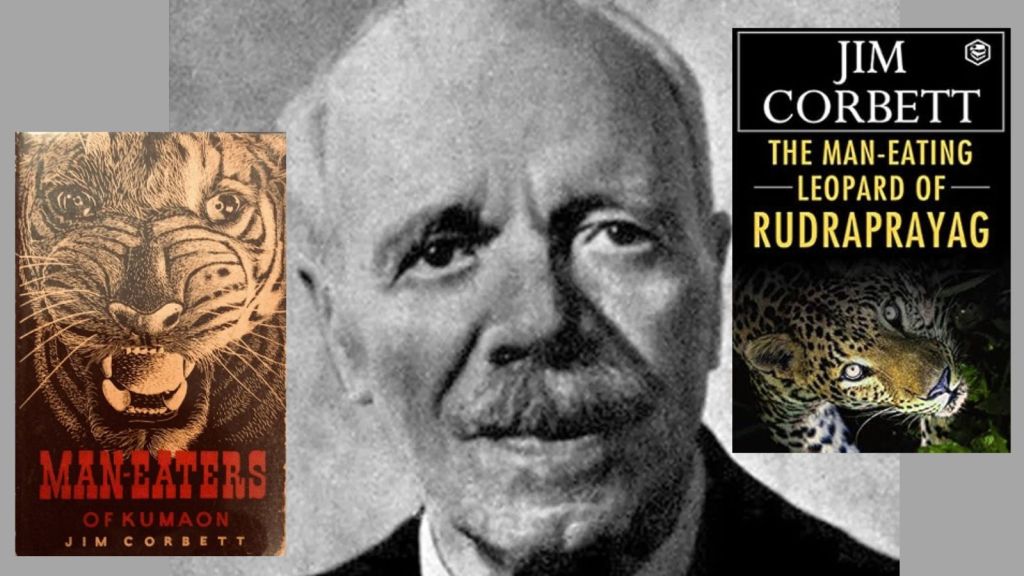 Between 1944 and 1955, Corbett published six books that transformed his adventures in the dense Indian jungles into literary legend. (Source: Wikimedia Commons and amazon.in)

 A clinical, community-focused narrative distinguished Corbett from other colonial-era shikaris, who often glorified the hunt and ignored its human context. (Source: amazon.in)
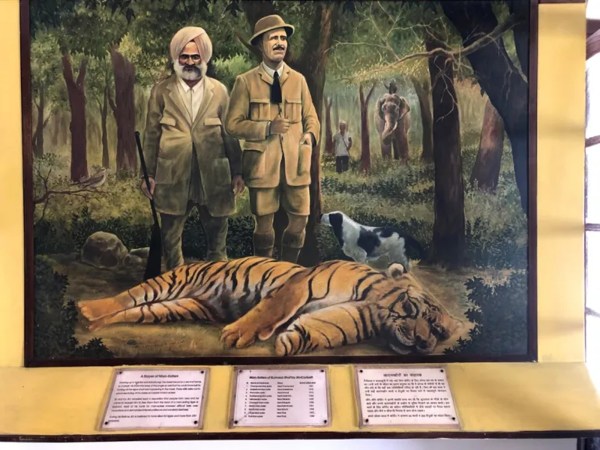 A painting at the Kaladhungi museum shows Corbett with a hunting partner and one of the tigers he shot. (Photo: Monojit Majumdar)
 In his later books, Corbett moved away from the act of hunting and toward reflection. (Source: amazon.in)


 Share


