


Journalism of Courage
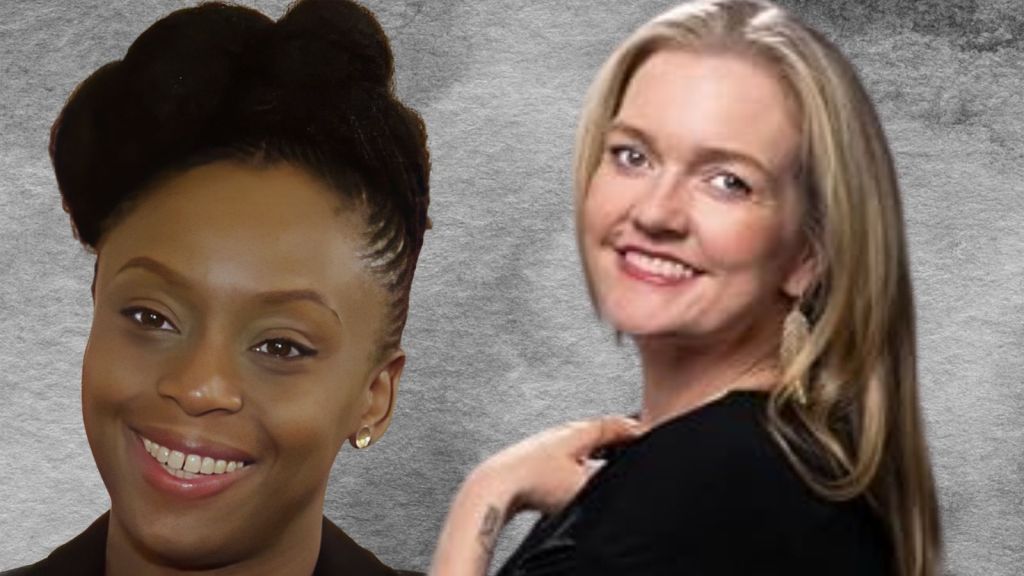 Chimamanda Ngozi Adichie and Colleen Hoover. (Wikimedia Commons/amazon.in)
Who is the better writer: Chimamanda Ngozi Adichie or Colleen Hoover? The question, purportedly debated at a book-club meeting, is circulating across bookish corners of social media, provoking discussion about literary snobbery, social-media-driven reading trends and what constitutes good literature.
Pitting Booker-longlisted Nigerian novelist Chimamanda Ngozi Adichie against Texas-based bestselling author Colleen Hoover, whose emotionally charged novels have become a phenomenon on TikTok’s book subcommunity, has not gone down well with many commentators, most of whom are baffled by the comparison.
“Are you for real?” one user asked on X. Another wrote: “A Colleen Hoover vs Chimamanda debate? Have we all lost our minds?”
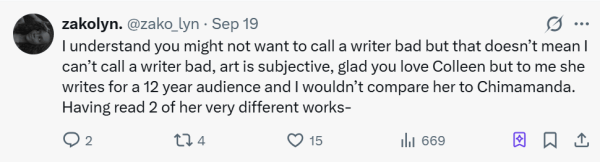 A screenshot from X.
Others called the comparison disrespectful to Adichie, saying she belonged to a more distinguished literary stratum comprising writers such as James Baldwin, Toni Morrison, Salman Rushdie and Chinua Achebe, while many found the question to be a case of rage-bait.
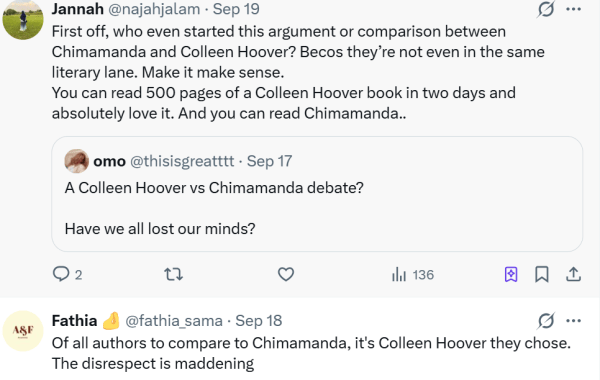 A screenshot from X.
While Adichie and Hoover’s writings belong to different literary genres, they both have considerable international followings.
Adichi writes about Nigerian history, migration, religion, race, feminism and the legacies of colonialism, while Hoover is known for her commercial romances and psychological fiction, often returning to trauma, grief, domestic abuse, loss and complicated relationships.
Adichi’s 2003 debut Purple Hibiscus was longlisted for the Booker Prize and Half of a Yellow Sun (2006) won the Orange Broadband Prize for Fiction, while Hoover is the winner of multiple Goodreads Choice Awards. At one point in 2022, six of Hoover’s books occupied the top 10 places on The New York Times paperback fiction bestseller list, and Time named Hoover one of its 100 Most Influential People of 2023.
So, by what criteria does one determine the better writer? Prose style, narrative structure, characterisation, ambition, emotional impact, accessibility or the ability to keep readers turning pages.
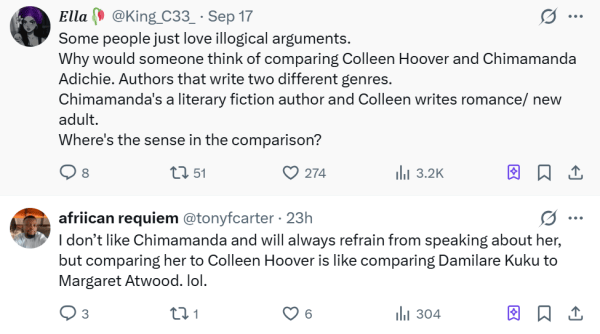 A screenshot from X.
While Adichi’s works are studied in universities, Hoover’s rise on book communities on TikTok and Instagram—where readers recommend, react to and review books—has drawn a new generation of readers to bookstores and libraries.
Hoover’s success also coincided with a much broader resurgence in romance, which was the fastest-growing category in the US in 2022, with industry analysts identifying BookTok as a significant contributor to the growth.
This raises the question that when millions of people are reading a genre, is it fair to compare them with literature and writers who have been canonised? And, more so is it fair to classify them as less than?
India has seen a version of this anxiety before. In the mid-2000s, Chetan Bhagat’s rise prompted similar debates about popularity and literary merit. Two States, published in 2009, sold 10 lakh copies in 10 weeks, according to Outlook, which described the figure as 100 times the number traditionally considered a hit for an Indian English novel in the pre-Bhagat era.
In a 2025 interview with The Indian Express, Bhagat addressed some critics characterising his writing as light or lowbrow. “It is light. Should there be no light reading? Light doesn’t mean it doesn’t have an impact. Books can be entertaining, believe it or not. That gateway into literature is Chetan Bhagat. And that I think is a good thing. It’s not gateway into cocaine, it is a gateway into books.”
The same argument can now be made for Hoover. Dismissing her work outright is often seen as a way of dismissing the reading pleasures of young women, romance readers and those who came to books through social media rather than university syllabi.
One might be tempted to resolve the argument by declaring Adichie writes “literature” while Hoover writes “commercial fiction.” But, this does not answer the question of literary quality, especially when the writers in question have different writing styles and subjects.
The answer will always be subjective depending on whether one likes to read for pleasure, escape, recognition, emotional catharsis, intellectual challenge or cultural understanding, which is perhaps why the Adichie-versus-Hoover debate seems to be a dust-up in a teacup.