


Journalism of Courage
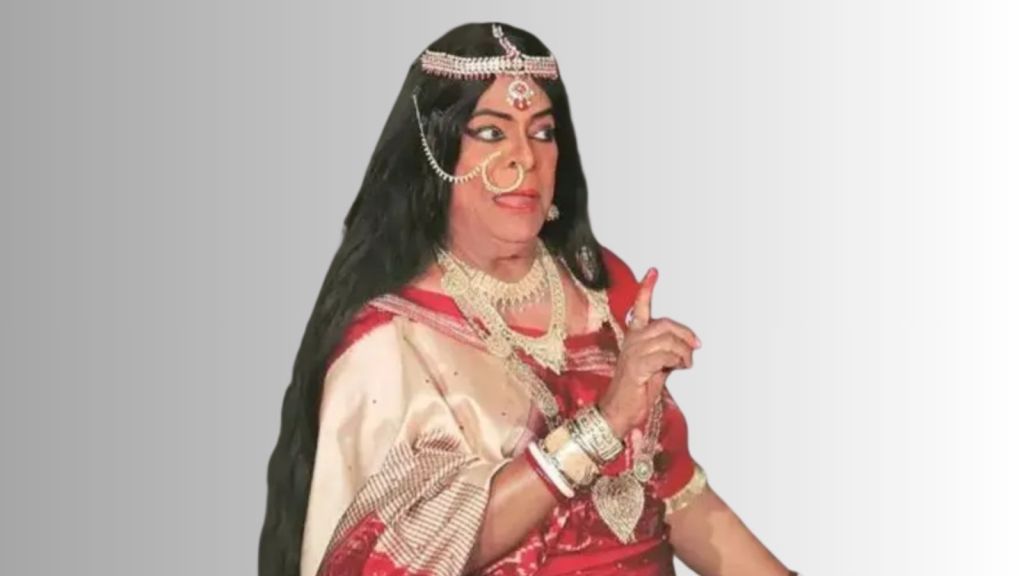 Chapal Bhaduri, during a performance in Delhi. (Express file photo by Renuka Puri)
(Written by Shreyoshee Palit)
At the height of his career, Chapal Bhaduri could command an audience as Chand Bibi, Sultana Raziya or Queen Kaikeyi. He was celebrated as Chapal Rani, one of West Bengal’s most famous male actors playing women on the jatra stage.
In the 1970s, however, as women began entering the jatra tradition in greater numbers, a different audience made its choice clear. During a performance in a college in West Bengal’s Uttarpara, a spectator threw a clay cup onto the stage and demanded a “real woman”. Bhaduri was 35. His career as a leading female impersonator was effectively over.
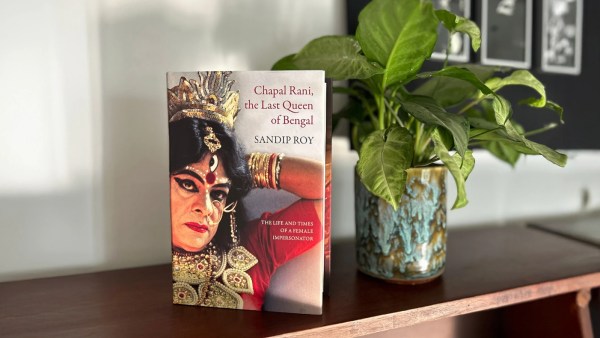 Sandip Roy’s Chapal Rani, The Last Queen of Bengal: The Life and Times of a Female Impersonator, published by Seagull Books. (Photo: sandiproy.com)
It is this dramatic rise and disappearance that lies at the heart of Sandip Roy’s Chapal Rani, The Last Queen of Bengal: The Life and Times of a Female Impersonator, published by Seagull Books. The 532-page book, Roy said in a recent conversation at JNU’s School of Arts and Aesthetics, with Professor Bishnupriya Dutt, began as a relatively simple attempt to record the life of a performer who was still alive. It eventually took him nearly five years.
At the discussion, Roy recalled that he had initially imagined putting a recorder in front of Bhaduri, transcribing his words and gradually shaping them into a book. But the interviews kept taking unexpected turns. Asked a question, Bhaduri would often take detours and begin reciting long passages from the jatra plays in which he had performed decades earlier.
When Roy later tried to procure some of those scripts, he discovered that many were out of print or simply unavailable— “And then I realised that there I was in 2023, listening to a man recite from memory pages and pages of dialogue he had done in 1961.” Bhaduri’s memory had itself become an archive, a testament to his passion and expertise.
Roy spoke about how he had grown up with the idea that jatra was for the “riff-raff”, while theatre belonged to the bhodro lok, or the respectable classes. People who remembered watching jatra as children often invariably told him that they had gone with cooks or domestic workers, not their parents. The form drew huge audiences, but its performers and histories were not documented with the same seriousness as more elite theatre traditions.
Bhaduri entered jatra partly out of necessity.
His education had ended after the eighth standard, and after his mother’s death, the family was struggling. After that, he started acting and taking on women’s roles in plays. From there, he became one of the most sought-after “Ranis” of jatra. By 1965, he was earning Rs 6,000 a month — an enormous amount at the time — and had acquired the temperament of a star.
Students drew connections between Bhaduri’s performances and ideas of gender performativity, but Roy opposed simple conclusions. In everyday life, Bhaduri was a conservative Bengali middle-class man. “He does not dress flashily outside, like on Jatra stage,” Roy said.
“He will wear a plain brown kurta or something like that and not draw enormous attention towards himself.” On stage, however, he took enormous pleasure in constructing his queen-ness — and in the attention it received. The two selves were connected, but could not be boxed.
One of the story’s most hard-hitting parts, however, comes after publication. The other celebrated “Ranis” of jatra often died in poverty. One stitched petticoats; another died by suicide after struggling to feed his family; another was found selling peanuts on the street.
There were no pensions, no safety nets and, eventually, few photographs to prove how famous these performers had once been. With only a handful of photographs of the young Chapal Rani surviving, Bhaduri was often the only person left who could bear witness to that vanished self.
That might ultimately be what the book is trying to do. Bhaduri was a performer once adored, then discarded by a changing industry; a man in a long relationship with another man decades before a visible queer movement could support him; and an artist whose world was dismissed as lowbrow even as thousands watched him perform.
Roy described the book at JNU as a form of validation: a way of saying that Chapal Bhaduri’s life mattered, that he mattered.
(The author is an intern with The Indian Express)