
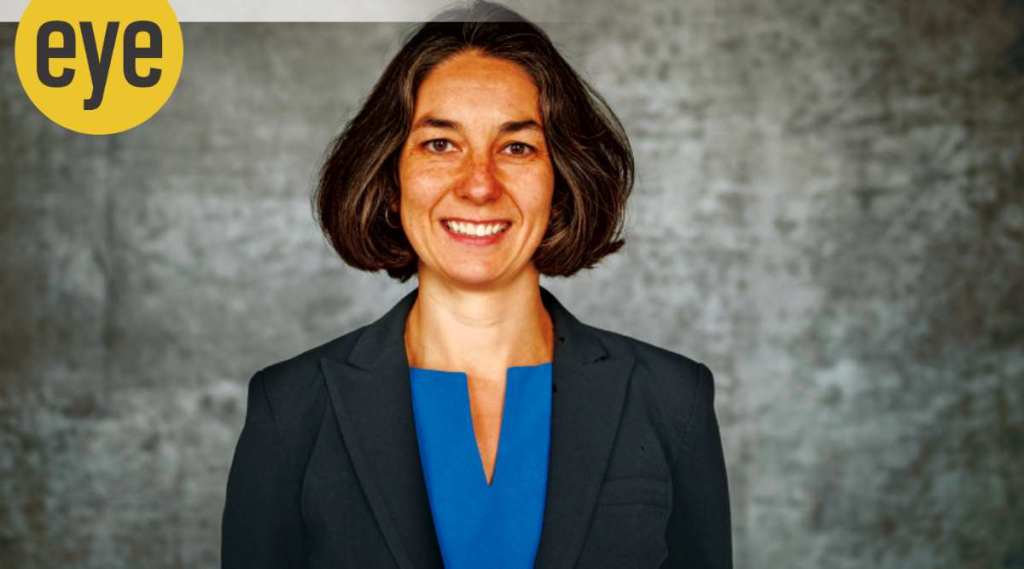
In her first book, Culture of Encounters (2016), historian Audrey Truschke had explored the crucial role played by cultural exchanges between the elites of the Mughal court and the Sanskrit-speaking populace in establishing the Mughals within the social, political and cultural framework of the region. Truschke had argued that the Mughal empire’s dynamism relied on its ability to embrace a wide range of cultural influences, especially Sanskrit.
The associate professor of South Asian History at Rutgers University, USA, returns to this theme in her third book, The Language of History: Sanskrit Narratives of Muslim Pasts, in which she analyses Sanskrit texts written between the 12th and 18th centuries to note an absence of any marked religious animosity between Hindus and Muslims in the subcontinent.

Truschke’s views are often met with virulent criticism by right-wing idealogues, that reached its peak with the publication of her second book, a biography of Mughal emperor Aurangzeb. In this interview, Truschke, 38, speaks of exploring the resilience of pre-modern India in her new book and her refusal to be stymied by the hate directed at her for countering propagandist readings of history or for calling out Islamophobia, sexism or human-rights violations around the world.
Excerpts:
You write in the epilogue of your new book that your attempt to broaden the scope of history might be misconstrued as a ‘de-emphasis on facts and accuracy’ How did you decide on the texts that you discuss?
Being written in Sanskrit was an iron-clad rule for inclusion but communicating accurate political history was not. As a result, I discuss texts that play fast and loose with the facts (for example, transposing chronologies), such as some of the 14th-century Jain prabandhas. I also analyse works that offer astonishing details of political intrigues — and even the Mughal king Farrukh Siyar’s medical history — such as Lakshmipati’s twinned early 18th-century histories (Nrpatinitigarbhitavrtta and Abdullacarita).
The book does not claim to be comprehensive, and I signal in the notes a number of texts that I hope other scholars might work on going forward.
In pre-modern India, Sanskrit was the language of power, but incoming language groups were also acknowledged, especially Persian, with words from it being incorporated into Sanskrit. Was this symbiosis a matter of pragmatism for wider dissemination of literary works or a reflection of the land’s cosmopolitan nature?
Treatment of Persian looks different among Sanskrit intellectuals than among other groups in pre-modern India. That’s because Sanskrit thinkers had to contend with a fairly robust, time-honoured set of philosophical positions that limited the number of literary languages. This hardly proved insurmountable, but it took a while for Sanskrit intellectuals to warm up to Persian. In the 12th century, for example, Jayanaka (Kashmiri poet-historian, composer of the Prthvirajavijaya) likened Persian to the cries of wild birds. By the 18th century, Lakshmipati (whose patron was Jagacchandra of Kumaon, who operated under the aegis of the Mughals) played with Persian, using Persian words and even bits of Persian grammar in Sanskrit. This journey is remarkable.
You write that Sanskrit intellectuals did not use the religious term ‘Musalmana’ for a very long time, because they saw Islamic incomers as just another addition to their socio-political set-up. How important was religious identity at the time?
There is a circa 700 CE use of ‘Musalamana’ in Sanskrit, which allows us to meaningfully ask: Why did hundreds of years pass before this more religious term was again used in Sanskrit? The answer, simply put, is that religious identity was not the one that most interested or concerned Sanskrit intellectuals who were thinking about Indo-Persian rulers.
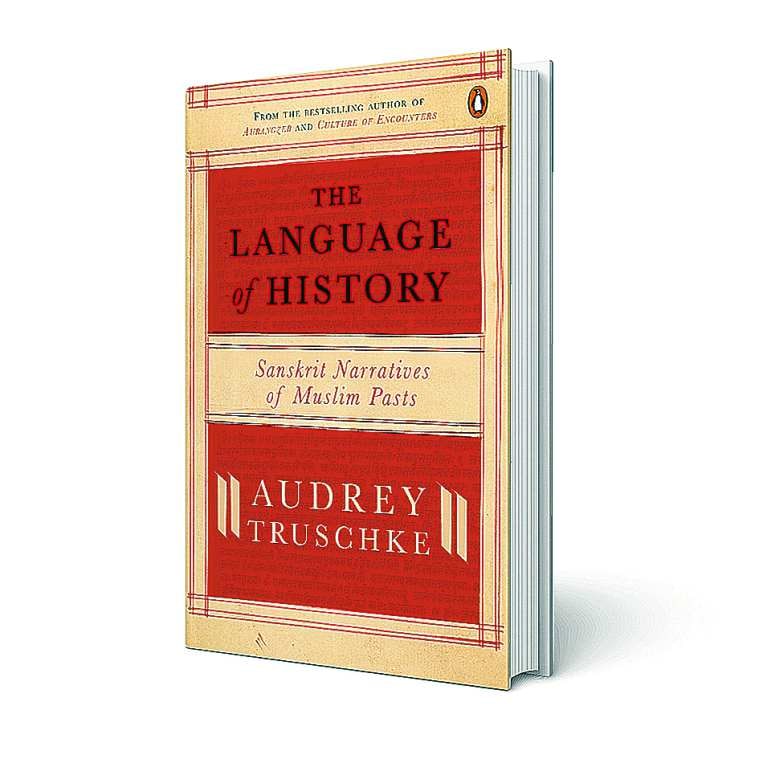 The Language of History: Sanskrit Narratives of Muslim Pasts by Audrey Truschke
You trace how Muslim patronage for Hindu temples was not uncommon, be it during the reign of the Khiljis or the Mughals or even earlier, just as desecration of temples was not a uniquely Islamic trait either. Is it the burden of colonial scholarship that the idea of the desecration of temples relates to Islamic rulers in popular imagination? How does one counter this ideological reading of the past?
There is a colonial history of misunderstanding temple desecration that has been enhanced by certain trends in independent India. In recent decades, a band of Hindu nationalist groups, who follow the ideology of Hindutva, have fuelled hatred of Muslims, including by maligning their imagined past deeds. This mythology is not just a colonial hangover. It is a critical part of India’s present, and Indian groups are responsible for this nexus of intolerance and bigotry. As a historian, my response is to meet this prejudice with knowledge. Alongside many colleagues, I research real aspects of Indian history and communicate them to anyone willing to listen.
While noting traces of the idea of Kashmiriyat — the notion of an indigenous, syncretic Kashmiri society — in a long tradition of Sanskrit writing from the region, you also caution against examining its present politics through the lens of the region’s pre-modern past. Could you elaborate?
Kashmiriyat is a lovely idea, but its historicity is another matter, as I indicate in the book. Scholarship on Kashmir has been hampered in recent years by the ongoing conflict in the region. I look forward to all involved actors respecting international agreements, halting human-rights violations, and allowing Kashmiris to use their inherent right of self-determination.
At the time of writing Aurangzeb: The Man and the Myth (2017, Allen Lane), you write that you’d been legally counselled to not venture into writing about Shivaji. You have taken it up in this book, exploring what led to Shivaji’s investment in projecting a Kshatriya identity for himself. Why was this critical for his political career? As a historian, how urgent is it for you to address revisionist tendencies?
Shivaji was a man of his times, and he cared a lot about caste and class. I know this is a sensitive subject for some today, but that is a modern, not a historical, problem. I try to recover history as accurately as possible, and I will publish as much of it as permitted within the legal and practical restraints of India’s anti-free speech laws and authoritarian turn. I have never and I will never change my historical opinion in the face of public pressure.
How do you cope with the abuse online?
With some difficulties, as anyone might experience, but overwhelmingly with conviction that I am doing my job ethically and to the best of my abilities. I have never given in to bullies or ignorance, and I am not about to start.
An old interview of yours, in which you speak of the harshness of the colonial reimagining of Aurangzeb as a religious bigot, keeps reappearing online, drawing flak. Do you think you can ever leave Aurangzeb completely in your past?
Sooner or later, a new historian will write a biography of Aurangzeb to supplant mine. Many of us look forward to that day, perhaps, for different reasons. In the meantime, the most recent, best work on Aurangzeb is by Richard M Eaton in his India in the Persianate Age: 1000-1765 (2019, Allen Lane), which is a must-read for all those interested in Indian history.

 Share


