Journalism of Courage



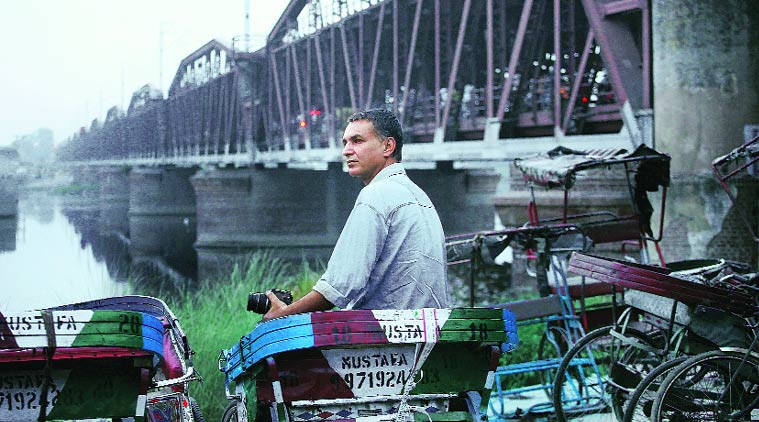 Inder Salim at the Loha Pul bridge on the Yamuna river in east Delhi
Artists have a complicated relationship with the city they live in — they critique it on canvases, celebrate it on cameras and claim it on walls. With Inder Salim, the bond gets a further twist. As the performance artist wanders around Delhi, where he has lived since his family fled Srinagar at the start of the unrest in Jammu and Kashmir in the Nineties, Salim pockmarks his most intimate locations with buttons. Called “Missing Button as Evidence”, this project is one of the many outlets for Salim’s creativity. “A personal element is always there in art. One doesn’t paint if one is not haunted by a particular thing,” he says.
His biggest project, at present, is planning an art extravaganza tentatively titled the Srinagar Biennale 2017, scheduled for January 2017. “One reason for choosing Srinagar is that the location is already charged. You don’t have to say ‘Look, we are in Srinagar and it is a political place’,” he says. January is an unusual month to choose for an art exhibition in the region where temperatures drop to sub-zero. “This was Jebeesh’s idea (Jeebesh Bagchi is one of the founders of Delhi-based arts organisation Raqs Media Collective and a collaborator of the Biennale). We want to do it in winter because, normally, art happens where you can go comfortably. Winter is a difficult time. Can art also happen when it is difficult, when the geography is not conducive, when the environment is hostile to experimentation? It is a challenge. Can it be done?” he says. The biennale will feature performance art as well as “paintings, the written culture and the oral culture”.
Salim is a familiar face in the Indian art circuit — and a confusing one. His support of bisexuality and gender equality, and the nudity and violence inherent in his best-known works have not brought him a lot of popularity. At one time, to protest the pollution of the river Yamuna (in Delhi), he presented a lyrical performance which ended with him chopping off his finger and throwing it into the water “to be a part of the river forever”. At a poetry event, Salim participated in the nude, with his penis stitched surgically to his navel. Before another event, he visited the Sir Gangaram Hospital in Delhi and asked a doctor to insert hooks on his back. He performed that evening, with poetry written on a piece of canvas dangling from the hooks. “Nothing should be excluded, not even nudity or even shit. I have done performances with shit, simply lifting shit of homeless people from the roadside and placing it in a jar of Formalin at Khoj. Immediately, it becomes like a laboratory specimen and we are forced to study it. How do you go closer to the other? That was the discourse,” he says.
He has a favourite pair of trousers that has featured in numerous performances; it is faded black and with the back cut open so that Salim’s bottom is exposed. “Women are vulnerable from the front, men are vulnerable from the back,” he explains.
Performance art is a new genre in India compared to music, dance, or theatre, and the worth of a performance is how much of himself an artiste invests in it. Consequently, body and pain become integral parts of performance art. Salim’s greatest influence has been the Dusseldorf-based artiste Joseph Beuys, whom he met and watched during a trip to Germany in 1999. “In the two months I was there, performance art became louder and louder in my ears because it was everywhere. I needed to know ‘What is life?’ I realised that when I changed my Kashmiri Pandit name, Inder Tikoo, to the conceptual Hindu-Muslim mix of Inder Salim. That was also a performance,” he says.
His first performance on returning to India was called Your Humble Servant, in which he spread his self-portraits on the floor of a gallery where audiences would walk, and served them drinks and snacks from a tray himself “just like a humble servant”. “It was not a comment, just an attempt to get out of this logjam in the gallery — there was an exhibition, there was photography, there was food, there was a banner outside, so many things were there. There was interactiveness also,” he says.
Salim is also a poet, painter and photographer, but once Inder Salim the performance artist was born, that is how he has been flagged and flogged among the art community and audiences.
Performance art maker Amitesh Grover says, “I have known only one Inder — the artist and the person in him are one. His poetry, his activism and his body coalesce into a lyrical, yet provocative, art practice. Inder is bold, insistent, and free-handed. His work is an inspiration to all subsequent generations of performance artists in India.”
Grover recalls a nude piece Salim had performed at KhojLive 2012 when “the audience was asked to surround a bed of turmeric, under which Inder had buried himself. After a while, the audience got worked up. There was no sign of a performance, simply a dying hope that something might happen. But nothing did, for a slow 30 minutes. And then, suddenly, Inder sprang up, piercing through the turmeric grave, with torn pages from the Constitution of India in his mouth, eating, reciting, chewing, dribbling, sputtering.” The performance was meant to protest an archaic British-era Dramatic Performance Act, which gives the state control over artwork.
Salim’s interests range from Kashmir to secularism, from gender to Basant Panchami. He depicted the last by performing a qawwali on stage at Jamia Milia University as he pulled out an unending swathe of yellow fabric from a hole in the wall. The cloth wrapped around Salim’s body and the young audience of students picked up the end and passed it around until there was a saffron-coloured ribbon looping through the hall in a picturesque experience of the spring festival. “The important thing in performance is that you move with the material. An idea can’t remain in the imagination, it has to come out. Artists have wings, and you have to keep developing so that the wings don’t dry up and fall off. You must always be ready to fly,” he says.

 6 min read