Journalism of Courage



 Ramzan Bazaar in Old Delhi (Source: Express Archive)
Eat, Pray, Love: For a short while, during Ramzan, faith, food and fellowship meet in one narrow, congested lane of Old Delhi
Two types of people gather at Gate Number One of Jama Masjid at sunset — those who have fasted through the day, and those who haven’t. The address they seek is not hard to find. All year around, the slate grey, ribbon-like lanes that snake between Turkman Gate and Jama Masjid have ageing names — Bazar Matia Mahal, Bazar Chitli Kabar — but, for one month, the area acquires a glitzy identity, the Ramzan Bazaar. Stalls pop up on either side of the lanes, cramped between extended shop-fronts that are laden with mountains of sweets and savouries. The darker the night, the thicker are the crowds.
They fill the lanes. Above their heads, stretches a net made of silver tinsel that is festooned with plastic flowers and bulging lanterns. The Jama Masjid, a 17th century mosque where Shah Jahan, the emperor of Hindustan, looked towards Mecca and bowed to the ruler of the universe, is a looming presence, the contours of its domes and towers highlighted by strings of light.
Ramzan, the holy month that Muslims dedicate to abstinence and prayer, is nearing an end. The Ramzan Bazaar, consequently, is packed with believers but it is possible that they are outnumbered by a secular crowd that is attracted by no higher impulse than to dig into delicacies available only at this time.
The hottest-selling item, literally, is piping hot Fried Chicken. Turmeric-coated whole chicks are piled like sand dunes on gigantic platters in stalls across the road.
[related-post]
Marinated chunks are dunked in massive cauldrons of sizzling oil and are served quickly with onion and chutney, for Rs 400 a plate. “It is crisp and very different from the fried chicken served by a famous multinational chain,” says Arun Kumar, an officer with the Department of Communication, who is here with friends.
 Paneer Jalebi Praveen Khanna (Source: Express Archive)
The other staple of the Dilli Gharana, the biryani, is hidden inside deghs but locals and serious foodies step beyond the bright lights for a taste to remember. The search for Tufeeq’s biryani is a culinary adventure — leave the comfort of the tinsel-ceilinged Bazar Matia Mahal and Bazar Chitli Kabar and enter a lane where the festivity is muffled and the light alternates between dim and absent.
After three left turns — keep asking for directions — in Haveli Azam Khan, the first clue is the faintest aroma of spices.
In true Old Delhi tradition, Dil Pasand Biryani Point aka Md Tufeeq’s and Md Umar’s landmark is a shelf with a degh outside a small room that has benches against walls. There’s always a cluster of people awaiting their turn.
The buff biryani, Rs 160 per kg, is made with secret recipes that include the harshingar, an autumn flower famous for its scent and saffron stalk. The meat is so tender, it comes apart into threads. “We start around 11 am and it’s all over by 3 am,” says Tufeeq.
The enduring charm of the Ramzan Bazar experience is that the food comes garnished with history and tradition. The calories have a meaning — to nourish the faithful who have fasted all day and to prepare them for the next fast that begins with sehri or the morning meal and prayer.
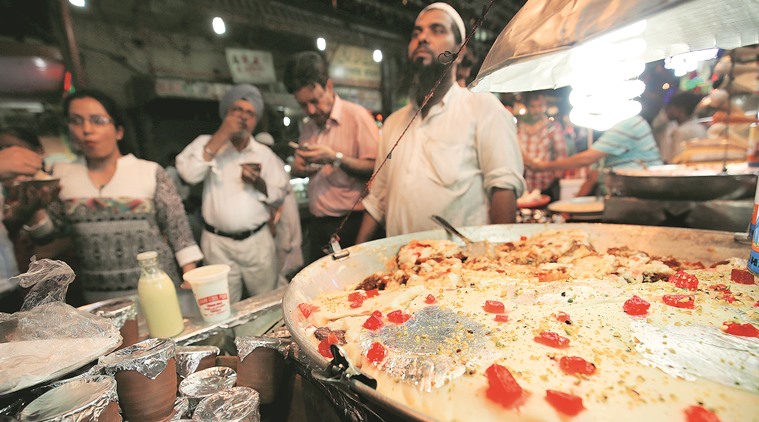 Shahi Tukda (Source: Express Archive)
Hence, the importance of khajla and a variety of breads that are packed with dry fruits, sugar, butter and oils and are to be soaked in boiled milk before eating. Sheermal and sevai, both factory and handmade, are to take away for a later binge. Cakes are the new favourites and, among the best are the soft fruit cakes found at Golden Bakery in different sizes priced between Rs 10 and Rs 60.
“People hold readings of the Koran in their homes and, after the session, they have started giving away cakes to guests,” says and Md Akil of the shop.
Kallan Sweets is in the front of the lane, overlooking the Jama Masjid, but people stop by after their fill of kebabs and biryani — unless they have sweet teeth the size of tusks and want to start the evening with dessert.
Reputed for its keema samosa, Kallan Sweets is also famous for paneer jalebi, among others. Unlike the regular jalebi that is a crispy tubing of sweet syrup, the paneer jalebi is made from a batter of cottage cheese and maida that is fried and cooled. The result is a crisp skin and a soft inside that melts with an explosion of sweetness.
The other famous dessert is the firni which is light and smooth because, as Md Naved of the shop says, “the rice is ground to a fine consistency, unlike the firni available in Uttar Pradesh”.
From the steps of Jama Masjid, the Ramzan Bazaar is a chaotic hive of activity, which should make it a living heritage of Delhi. People tuck into delicacies, standing around stalls, and rush to the next gastronomic landmark.
The Bazaar will disappear after Eid but, for now, the faithful and the foodie have come together to celebrate the sweet and the spicy.

 5 min read