6 min read
Stay updated with the latest - Click here to follow us on Instagram

Journalism of Courage



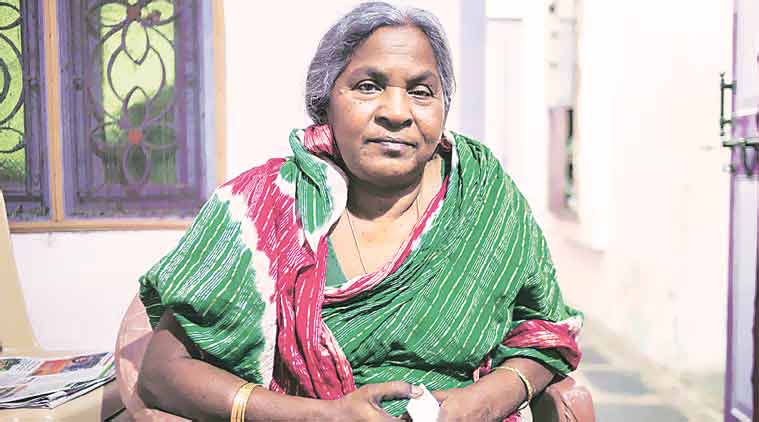 Anjani died a month after Rohith Vemula’s suicide. (Express Photo: Harsha Vadlamani)
The one-man judicial commission that inquired into the suicide of PhD scholar Rohith Vemula said that his mother’s claim that her foster parents had told her that her biological parents were SC was “improbable and unbelievable”. In a recorded conversation with this newspaper in February, days before her death, Radhika’s foster mother, Anjani Devi, had given enough indication that her daughter knew of her Dalit identity.
Watch| Rohith Vemula Not A Dalit, Neither His Mother: HRD Commission’s Findings
Devi, who belongs to the backward Vaddera community, had told The Sunday Express that the labourer-parents of her adopted daughter belonged to the SC Mala caste and that she retained that identity.
Also Read: Probe alleges Rohith Vemula’s mother faked Dalit status, blames him for his suicide
Devi, a retired school headmistress, passed away in Guntur on February 23, 26 days after the one-man commission of retired Allahabad High Court judge A K Roopanwal was set up by the HRD Ministry.
Read | Rohith Vemula was not a Dalit, says probe panel set up by HRD Ministry
Speaking to The Sunday Express in an interview published on February 14, Devi, a widow, had said: “Radhika is the second daughter of a SC-Mala couple who worked as railway labourers. They were working near my house at that time and on the day they were moving away from here I took her from them and adopted her. Bodduamma (later named Radhika) is the second girl child of that migrant couple working on the railway track some 45 years ago. She was very fair and cute and crawling all over the place, probably just over one year old at that time. I saw how poor they were as they left her under a tree all day as they toiled. Even without inquiring I knew they were from SC Mala community… which I also later confirmed. I had just lost a girl child, who was born after two sons. I was distraught and asked the labourers if I can adopt the baby. They readily gave her away and I brought her home and named her Radhika.”
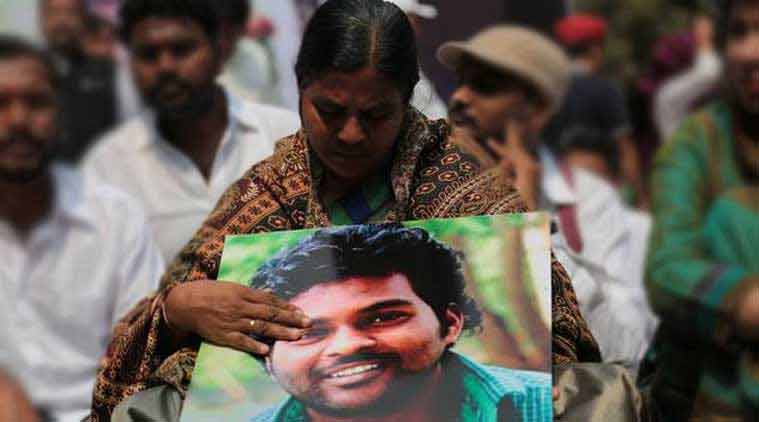 Rohith Vemula’s mother, V Radhika, holds a picture of her son during a protest. (Express Photo)
Devi had said that her relationship with Radhika changed five years after her marriage and worsened when her adopted daughter decided to take up her caste as SC-Mala. By then, Radhika had separated from her “alcoholic” husband, Devi had said.
Also Read: Story of the ‘city girl’ from Guntur grieving for her son — Rohith Vemula
Describing the circumstances behind Radhika’s marriage, Devi had said, “The boy’s grandfather is very well known in Gurazala as a philanthrophist. We didn’t hide the truth about Radhika’s adoption and told him that she was from an SC family but raised as a Vaddera. He had no objection. Unfortunately, Radhika’s husband Manikumar turned out to be a drunkard.”
Roopanwal had asked in his report that if Radhika’s foster family did not disclose the names of her biological parents, how could they have revealed their caste to her.
Radhika, however, expressed outrage at the commission’s conclusions and accused it of trying to divert the issue to caste, “instead of investigating the causes that led to Rohith’s suicide”.
Among its findings submitted in August, as reported by The Indian Express on Thursday, the commission concluded that Rohith’s death was caused by personal frustration, not discrimination.
“When Rohith never opted for reservation or any quota as Dalit, and always applied under general category, why has his caste become so important? Why does no one want to investigate what forced him to commit suicide?’’ said Radhika.
“Why would I fake my caste? I was born in the (Mala) caste. We are Dalits, no one can take that away from us. I have certificates issued by the government to prove my caste. And why is caste being given more importance in this inquiry than the reasons and the people who drove my son to commit suicide? No one is talking about the events in the university that led to my son’s death. Every inquiry has taken a wrong direction,’’ said Radhika.
Rohith, 26, committed suicide by hanging on January 17 in a friend’s hostel room, a few weeks after he was asked to leave the Hyderabad central university hostel as part of disciplinary action against a group of six Dalit students following an alleged confrontation with an ABVP leader over a Facebook post.
Asked about the inquiry’s findings, Rohith’s younger brother Raja said that it exceeded its terms of reference to protect those who allegedly drove Rohith to commit suicide. “He was supposed to investigate the happenings in the university, the role of the vice-chancellor and others who recommended the punishment, and the circumstances that drove my brother to suicide. Instead, he has diverted the entire probe to caste. This has been done to protect Union Minister Bandaru Dattatreya and Vice-Chancellor P Appa Rao from action under the SC/ST Atrocities Act,’’ Raja alleged.
The Indian Express had reported that Union Labour Minister Dattatreya had written to the HRD ministry in August 2015, accusing the university of being “a mute spectator” after the Dalit students clashed with the ABVP leader.
This newspaper had also reported that a month before his suicide, Rohith had written a letter to vice-chancellor Appa Rao, seeking euthanasia facilities for Dalit students after his stipend was stopped following the disciplinary action over the confrontation.
The one-man commission probing the suicide had also concluded in its 41-page report that expelling Rohith from the hostel was the “most reasonable” decision the university could have taken; Union ministers Dattatreya and Smriti Irani, the then HRD Minister, were only discharging their duties; and, there was no pressure on the Hyderabad Central University authorities while taking action against the Dalit students.
Stay updated with the latest - Click here to follow us on Instagram